
Thermal interface materials (TIM) are critical to the reliability of batteries, power modules and electronic assemblies. By replacing microscopic air gaps between components and heat sinks, TIMs help reduce thermal resistance, improve heat dissipation and support stable operating temperatures. This guide explains the main TIM families, key technical properties and practical selection criteria for EV, ESS and power electronics applications.
Values shown are indicative portfolio ranges for reference only. Grade-specific values vary with filler package, bond-line thickness, pressure, surface condition, cure profile and measurement method, and should be confirmed by the product TDS.
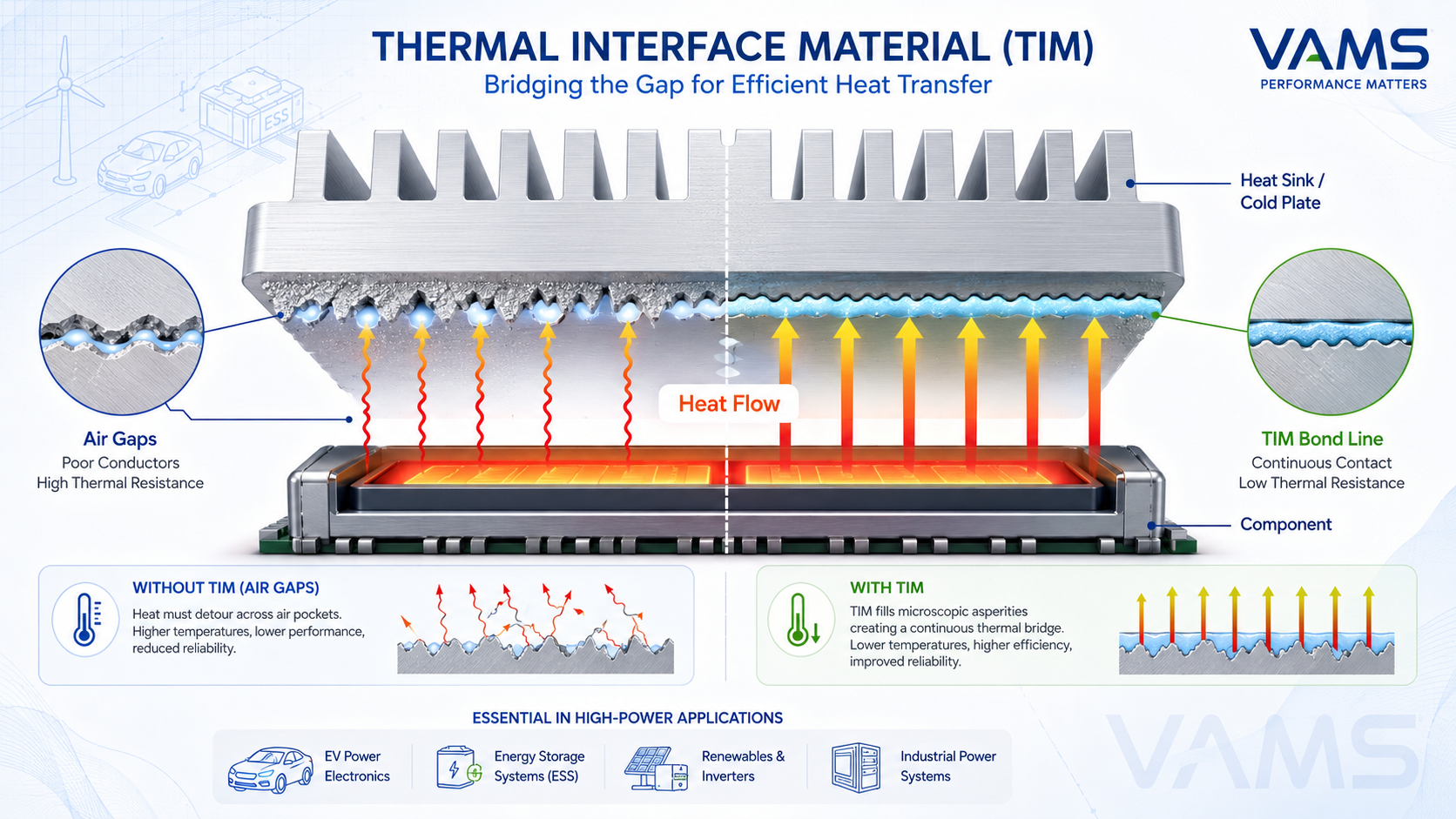
A TIM replaces insulating air gaps with a continuous conductive path between component and heat sink
What a TIM Does
Two solid surfaces — a power device and a cold plate, for example — only touch at a few microscopic peaks. The rest is air, which is a poor conductor. A TIM fills those gaps so heat can flow across the joint. The total interface resistance has two parts: the bulk resistance of the TIM (thicker bond line = more resistance) and the contact resistance at each surface (how well the TIM wets and conforms). Good TIM selection minimizes both.
In real applications, the highest thermal conductivity is not always the best solution. A thinner bond-line, better wet-out and lower contact resistance can deliver better performance than simply choosing the highest W/m·K material. TIM selection should therefore focus on total thermal impedance under actual assembly pressure and operating conditions.
- Lower thermal resistance: conductive path from junction to heat sink or cold plate
- Gap and tolerance filling: conforms to surface roughness, warpage and stack-up gaps
- Low mounting stress: soft grades protect fragile dies, cells and substrates
- Dielectric isolation: most TIMs are electrically isolating between part and sink
- Reliability: stable through thermal cycling, vibration and long service life
TIM Types
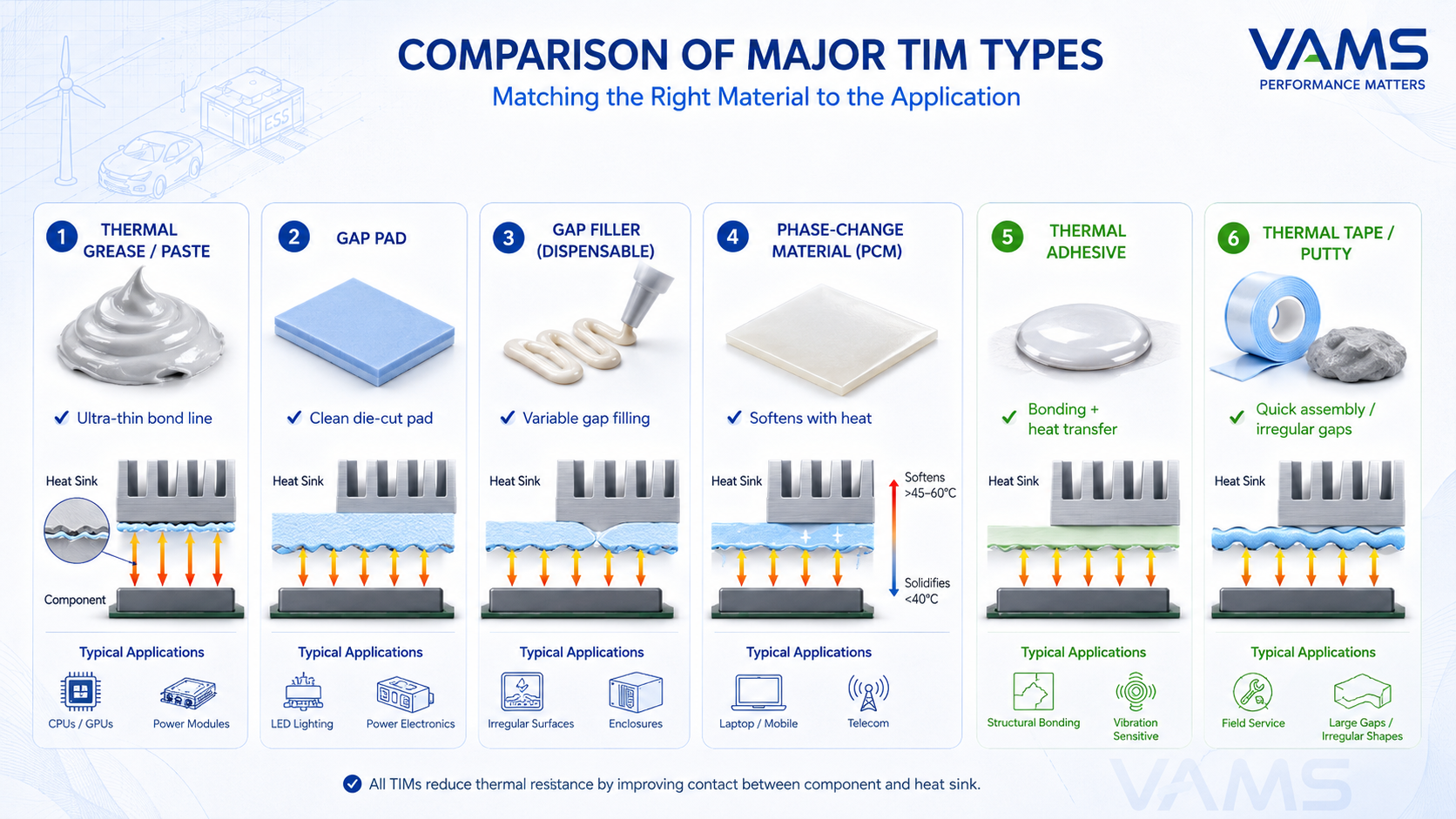
Major TIM types compared — grease, gap pads, gap fillers, phase-change materials, adhesives and tapes
Thermal Grease / Paste
Provides very low bond-line thickness and low thermal resistance on flat, well-mated surfaces. It requires mechanical fastening and should be validated for pump-out, dry-out and long-term thermal cycling stability.
Gap Pads (pre-cured)
Die-cut, soft elastomer pads for fixed gaps, with clean handling and electrically insulating options. Suitable when reworkability, clean handling and defined thickness are important.
Gap Fillers (dispensable)
1K/2K dispensable, thermally conductive materials that flow to fill variable gaps in a single pass. Commonly used for battery modules, large-area cooling plates and electronic housings where tolerance variation must be absorbed with low compression stress.
Phase-Change Materials (PCM)
Solid at room temperature and designed to soften at operating temperature, allowing the material to wet the surface like grease while maintaining pad-like handling. Offers improved pump-out resistance compared with conventional grease in many designs.
Thermal Adhesives
Conduct heat and bond mechanically at the same time, fixing heat sinks or components when clips and screws need to be eliminated. Available as RTV silicone or epoxy systems.
Thermal Tapes & Putty
Double-sided conductive tapes for fast bonding and soft putties for filling irregular gaps. A convenient solution for quick assembly, irregular gaps or lower-power interfaces.
Key Properties
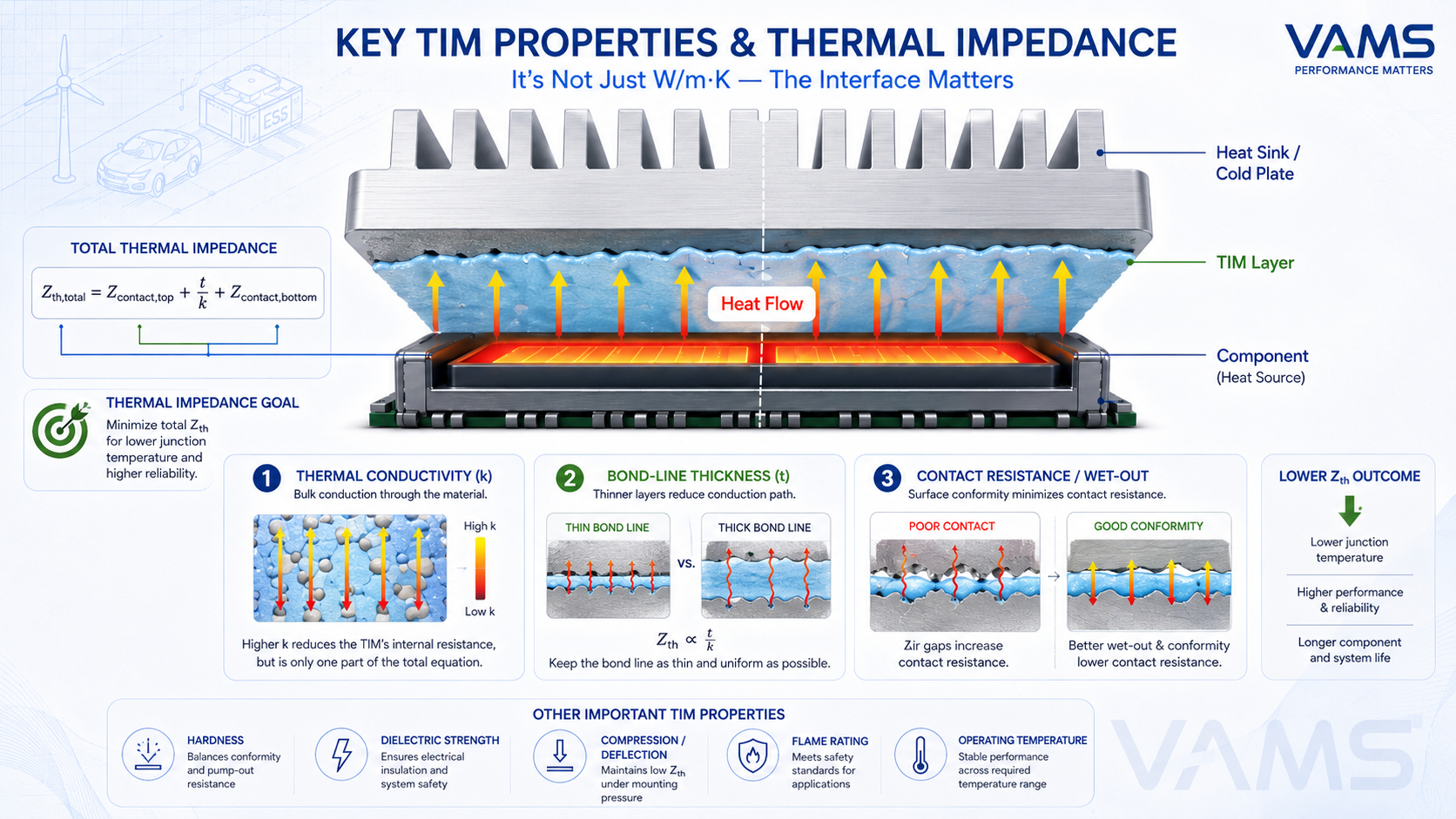
Key TIM properties — conductivity, thermal impedance, bond-line thickness and contact resistance
| Property | Standard / Method | Why It Matters |
|---|---|---|
| Thermal conductivity (k) | ISO 22007 / ASTM D5470 / hot-disk | Bulk heat conduction capability (W/m·K) |
| Thermal impedance / resistance | ASTM D5470 | Practical interface performance under defined pressure and bond-line thickness |
| Bond-line thickness (BLT) | — | Thinner bond line lowers resistance — design to minimum |
| Hardness | Shore 00 / OO / A | Softer = better conformity and lower mounting stress |
| Dielectric strength | IEC 60243 / ASTM D149 | Electrical isolation between component and sink |
| Compression / deflection | ASTM D575 or internal method | Defines assembly stress on battery cells, PCBs, ceramic substrates and modules |
| Flame rating | UL 94 | Important for EV battery, ESS and power electronics safety requirements |
| Operating temperature | — | Continuous service range (e.g. −50 to +200°C for silicone) |
| Outgassing / reliability | ASTM E595, thermal cycling | Stability and pump-out resistance over life |
Indicative methods and ranges across TIM families. Confirm certified, grade-level values with the product TDS.
Selection Guide
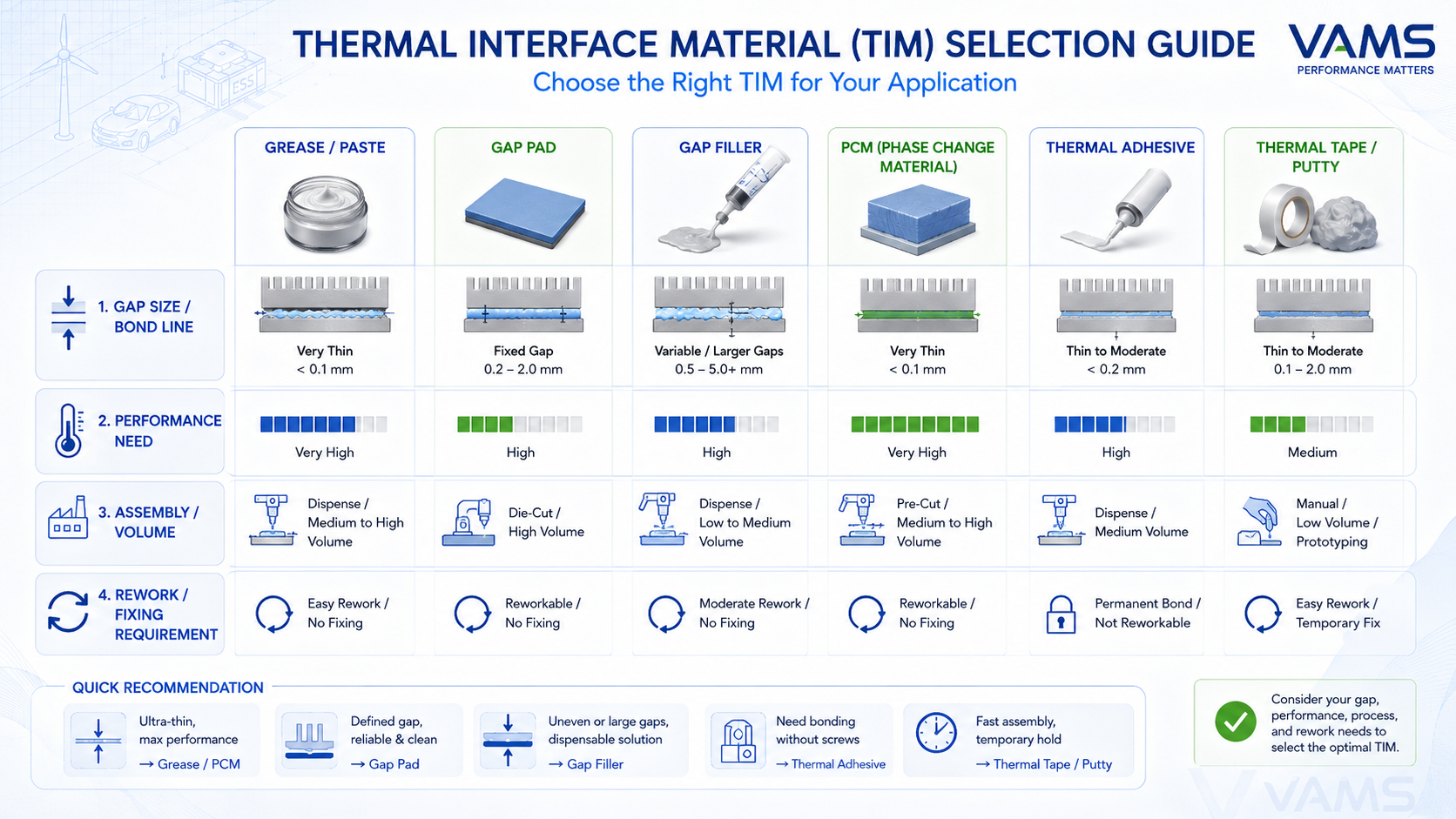
Selecting a TIM by gap, heat load, conductivity, dielectric, reworkability and process
| TIM Type | Typical k (W/m·K) | Gap / Bond Line | Best Fit |
|---|---|---|---|
| Thermal grease / paste | 1–15 | Very thin (<100 µm) | Flat, mated surfaces requiring very low bond-line resistance |
| Gap pad | 1–6 | 0.5–5 mm fixed | Fixed gaps, clean handling, lower volume |
| Gap filler (dispensable) | 1–6 | 0.5–5 mm variable, depending on material grade and design | Variable gaps, automated high volume |
| Phase-change material | 1–8 | Very thin | Improved pump-out resistance with low interface resistance |
| Thermal adhesive | 0.5–3 | Thin–medium | Bonding heat sinks without fasteners |
| Thermal tape / putty | 0.5–3 | Thin–irregular | Fast assembly, irregular gaps |
Flat, high-power interfaces → grease or PCM
Large-area battery cooling or variable gaps → dispensable gap filler
Fixed gaps and clean assembly → gap pad
Bonding without screws or clips → thermal adhesive
Applications
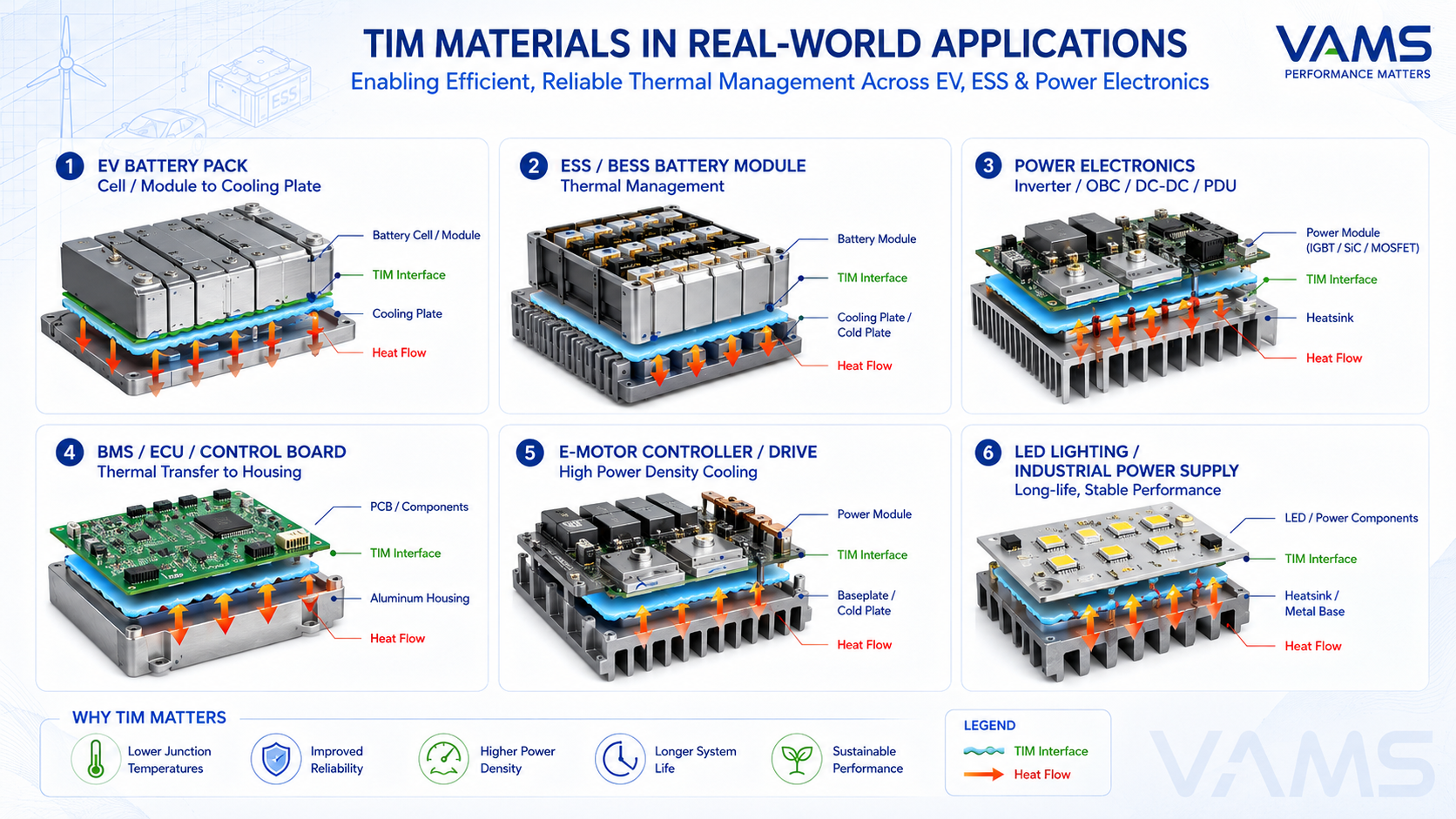
TIM applications across EV battery packs, power electronics, BMS/ECU, motor drives, LED and ESS
- EV battery packs: cell or module to cooling plate, using gap fillers and pads for low-stress, large-area cooling
- ESS / BESS battery modules: module-to-cooling-structure or enclosure thermal management
- Inverter / OBC / DC-DC / PDU: power modules, MOSFETs, IGBT and SiC devices to heat sinks or cold plates
- BMS / ECU / control boards: heat-generating ICs to housings, frames or local heat spreaders
- E-motor controllers and drives: power stages to chassis or liquid-cooled cold plates
- LED and lighting modules: LED boards and drivers to heat sinks
- Telecom and industrial power supplies: RF power, PSUs and embedded boards to enclosures
Design & Process Notes
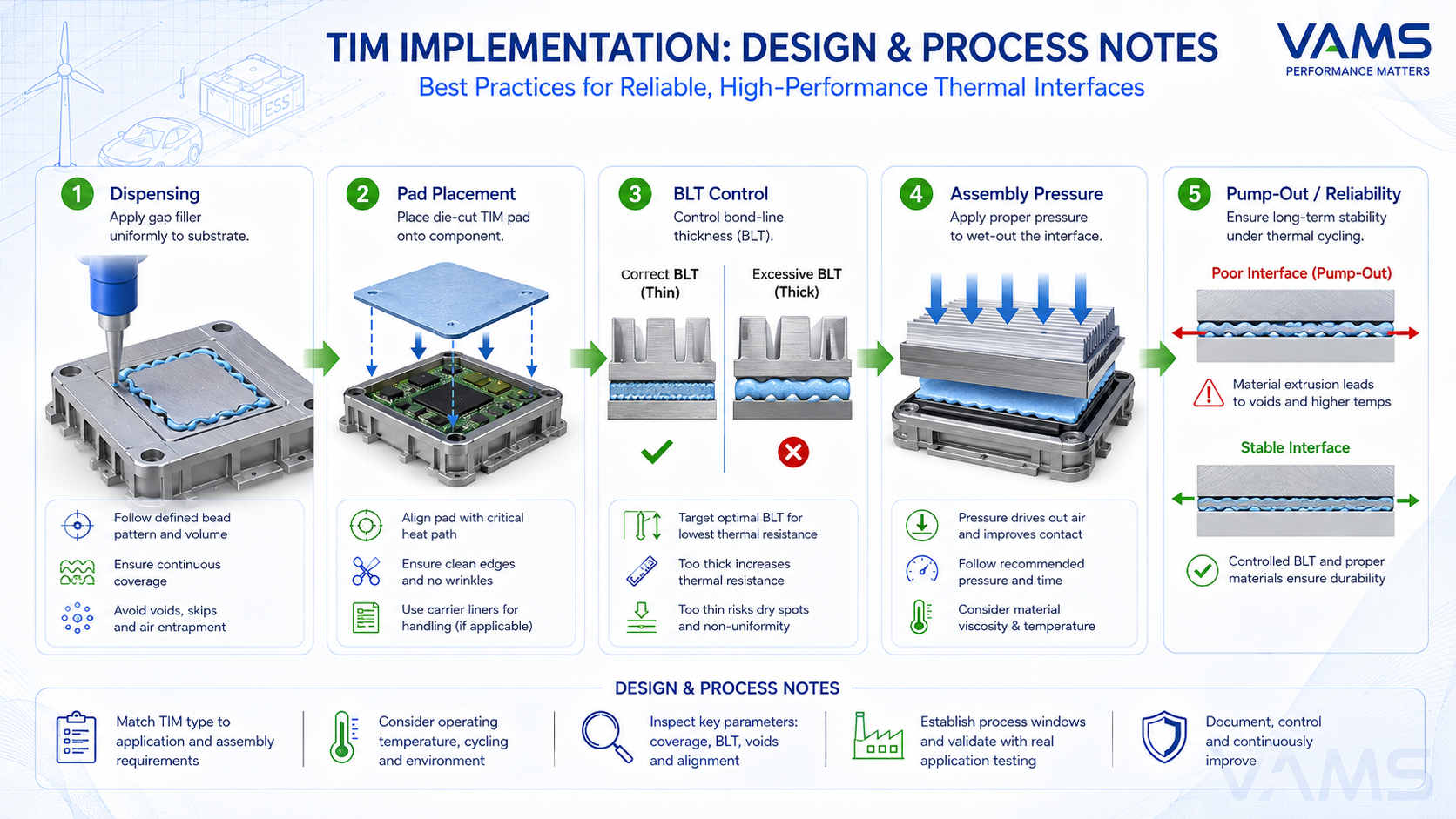
Implementation notes — bond-line control, dispensing, wet-out and pump-out over thermal cycling
- Design to minimum bond line: thermal resistance scales with thickness — keep the gap as small as tolerances allow
- Match conductivity to heat load: over-specifying thermal conductivity may increase cost, density, viscosity and dispensing wear without proportional thermal benefit
- Control pressure & wet-out: impedance is measured at a given pressure — define assembly force and dwell
- Pump-out & dry-out: for grease, verify long-term stability; PCM or cured fillers may offer better pump-out resistance depending on design and operating conditions
- Dispensing: dispensable fillers suit meter-mix-dispense (MMD) and robotic dispensing lines; abrasive fillers need hardened wetted parts
- Rework: some silicone pads or cured gap fillers may support module removal depending on adhesion, cure state and service requirements
Common Selection Mistakes
- Selecting TIM only by W/m·K while ignoring total thermal impedance
- Using a gap pad when the actual gap tolerance is too variable
- Applying too much grease, creating excessive bond-line thickness
- Ignoring compression stress on battery cells, PCB components or ceramic substrates
- Not validating pump-out, dry-out and thermal cycling performance
- Overlooking dispensing process limits such as viscosity, filler abrasion, pot life and cure behavior
Why VAMS
- Full TIM portfolio including grease, gap pads, dispensable gap fillers, phase-change materials, thermal adhesives, tapes and putties
- Portfolio options from low-stress, electrically insulating grades to higher-conductivity materials; UL 94 V-0 options available depending on product grade
- Application-based material selection by gap, heat load, pressure, dielectric requirement, reworkability and production process
- Process support for bond-line design, thermal impedance targeting, dispensing method, pump-out evaluation and reliability validation
- TDS/SDS and project documentation support for EV, ESS/BESS, e-motor and power electronics customers
- Local technical support, sampling coordination and documentation support for customers in Vietnam and Southeast Asia