
Seam Sealing for Body-in-White
Water-tight, corrosion-resistant sealing for welded BIW joints
Values are typical reference ranges and may vary depending on sealer chemistry, bead geometry, substrate condition, paint-shop process, cure schedule, application method and OEM validation standard.
Every welded seam in a BIW can become a pathway for water, air, dust and noise if not properly sealed. Seam sealers form a flexible protective barrier over flanges and weld lines — applied in the paint shop before or after e-coat — to support corrosion resistance, water-tightness, NVH performance and finish quality. This guide covers chemistries, application methods and process windows.
Application Zones
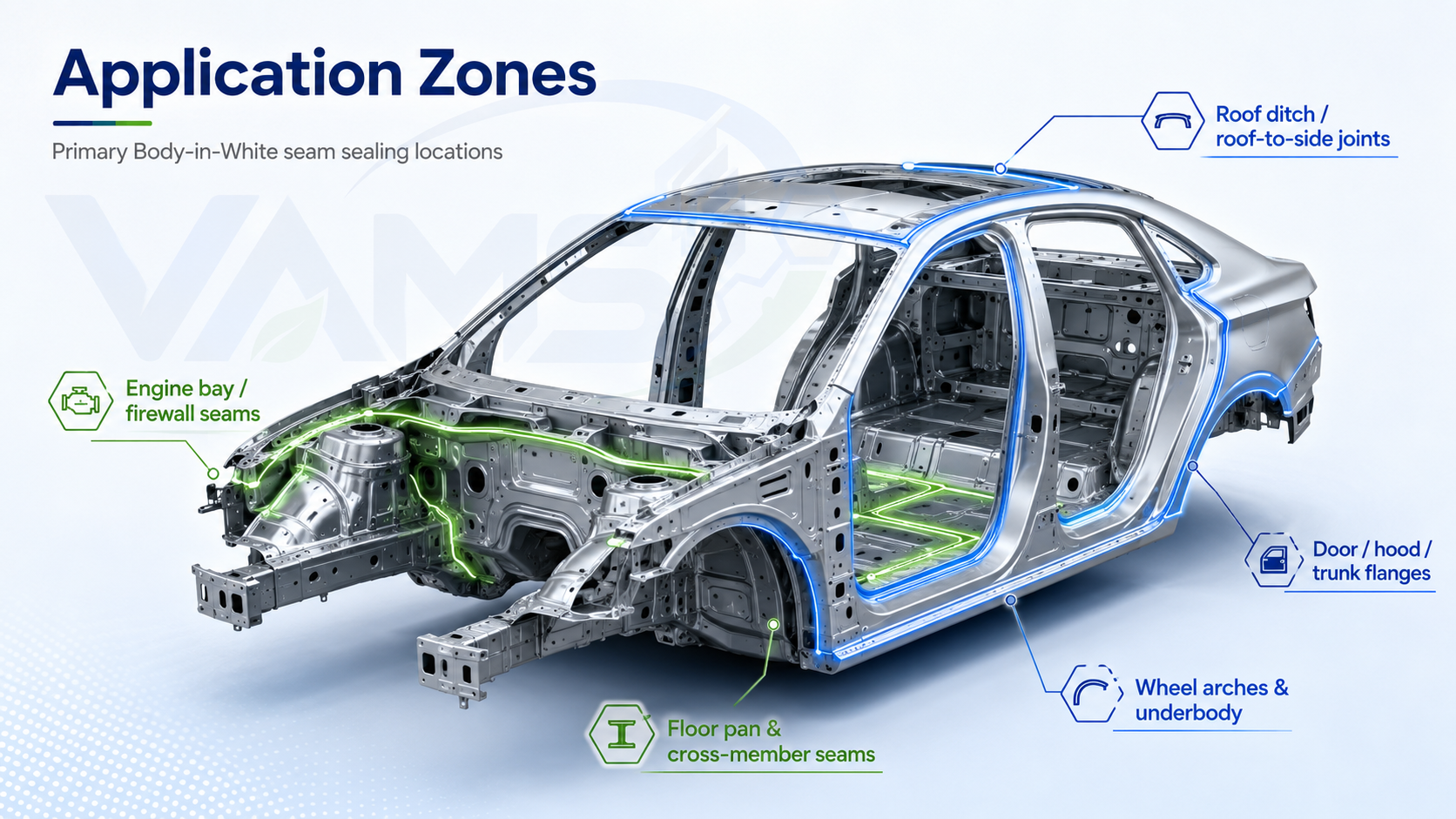
Welded-seam sealing locations across floor, wheel arches, roof ditch and closures
- Floor pan & cross-member seams: water and exhaust-gas tightness
- Wheel arches & underbody: corrosion + stone-chip transition with underbody coating
- Roof ditch / roof-to-side joints: water management and finish
- Door, hood, trunk flanges: dust/water sealing, NVH
- Engine bay / firewall seams: sealing against fluids and noise
Chemistry & Type Selection
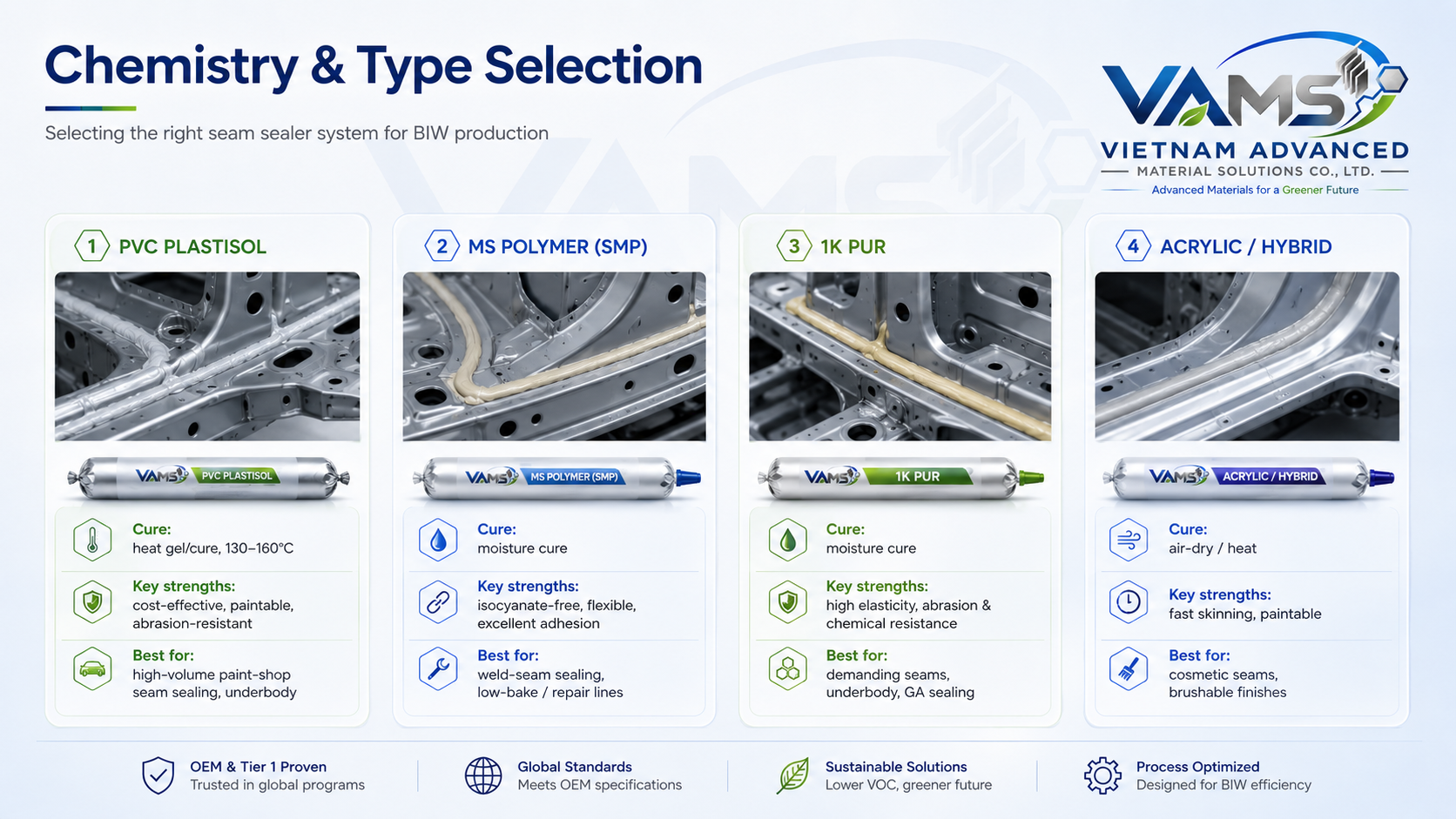
PVC plastisol, MS-polymer and PUR sealer chemistries for BIW seams
| Type | Cure | Key Strengths | Best For |
|---|---|---|---|
| PVC Plastisol | Heat gel/cure, 130–160°C | Cost-effective, paintable, abrasion-resistant | High-volume paint-shop seam sealing, underbody |
| MS Polymer (SMP) | Moisture cure | Isocyanate-free, flexible, excellent adhesion | Weld-seam sealing, low-bake / repair lines |
| 1K PUR | Moisture cure | High elasticity, abrasion & chemical resistance | Demanding seams, underbody, GA sealing |
| Acrylic / hybrid | Air-dry / heat | Fast skinning, paintable | Cosmetic seams, brushable finishes |
Application Methods
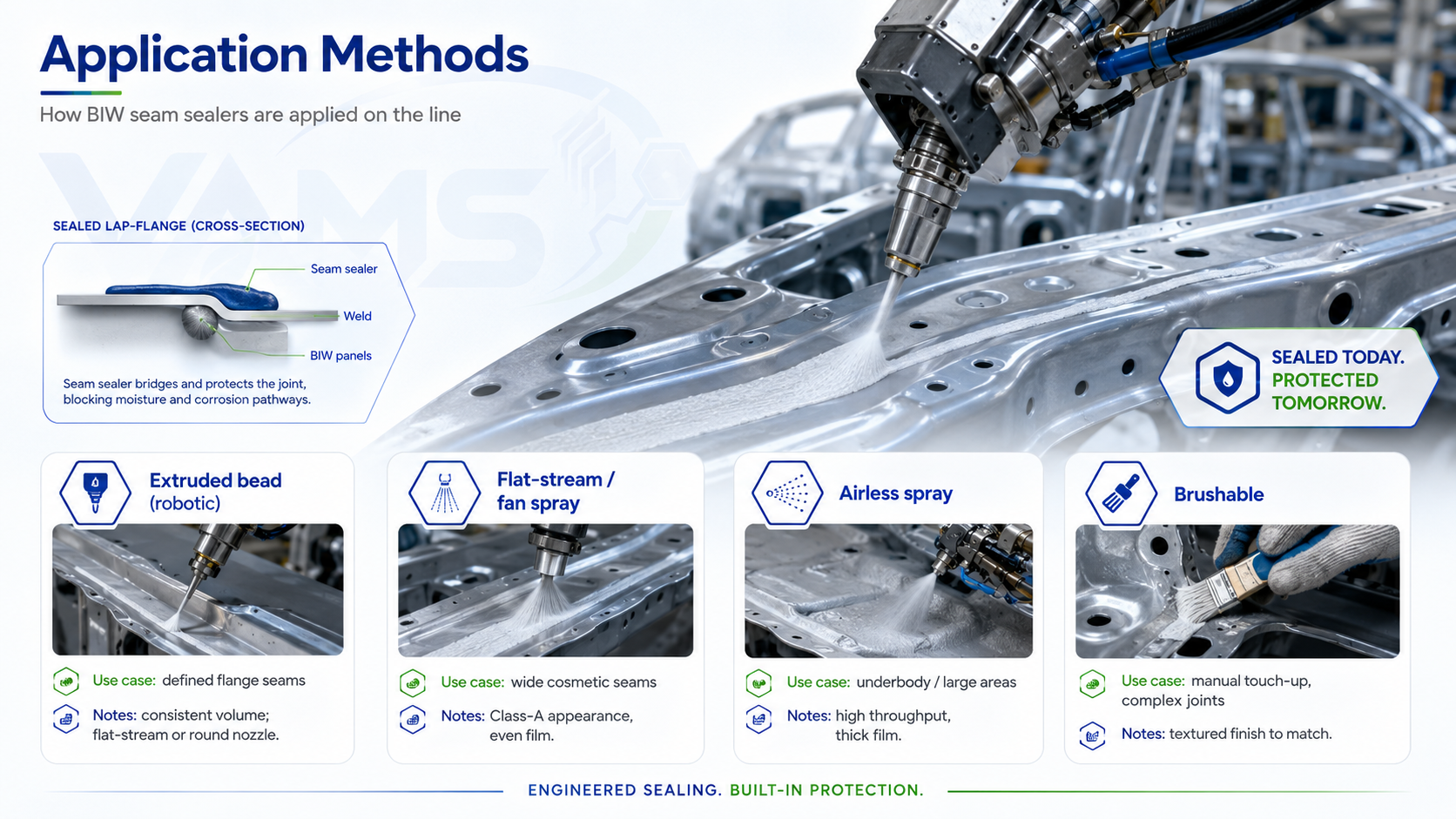
Extruded bead, flat-stream / airless spray and brushable application methods
| Method | Use Case | Notes |
|---|---|---|
| Extruded bead (robotic) | Defined flange seams | Consistent volume; flat-stream or round nozzle |
| Flat-stream / fan spray | Wide cosmetic seams | Class-A appearance, even film |
| Airless spray | Underbody / large areas | High throughput, thick film |
| Brushable | Manual touch-up, complex joints | Textured finish to match |
Typical Properties
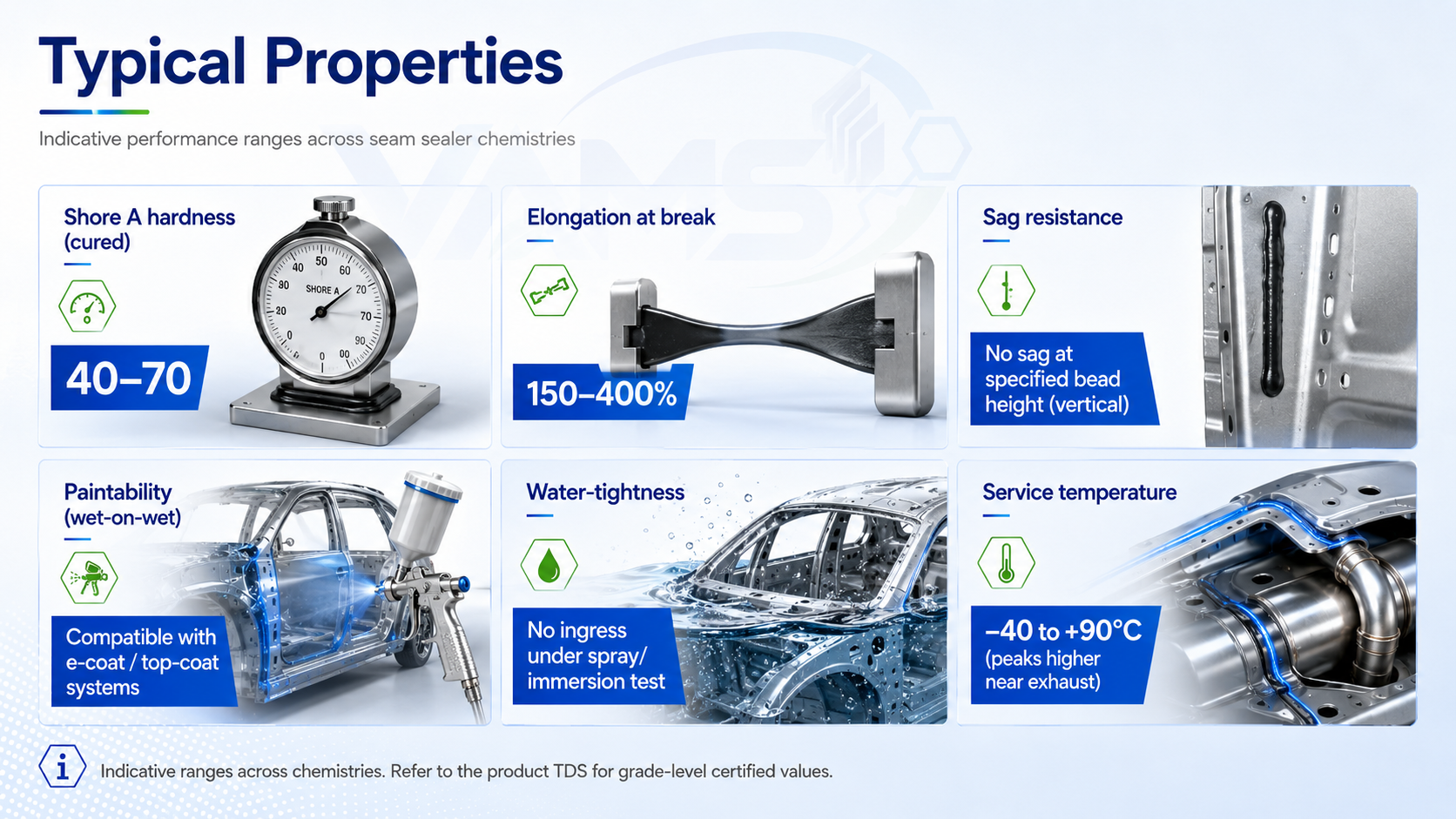
Typical sealer properties — hardness, elongation, sag resistance and water-tightness
| Property | Indicative Value |
|---|---|
| Shore A hardness (cured) | 40–70 |
| Elongation at break | 150–400% |
| Sag resistance | No sag at specified bead height (vertical) |
| Paintability (wet-on-wet) | Compatible with e-coat / top-coat systems |
| Water-tightness | No ingress under spray/immersion test |
| Service temperature | –40 to +90°C (peaks higher near exhaust) |
Indicative ranges across chemistries. Refer to the product TDS for grade-level certified values.
Process & Quality Notes
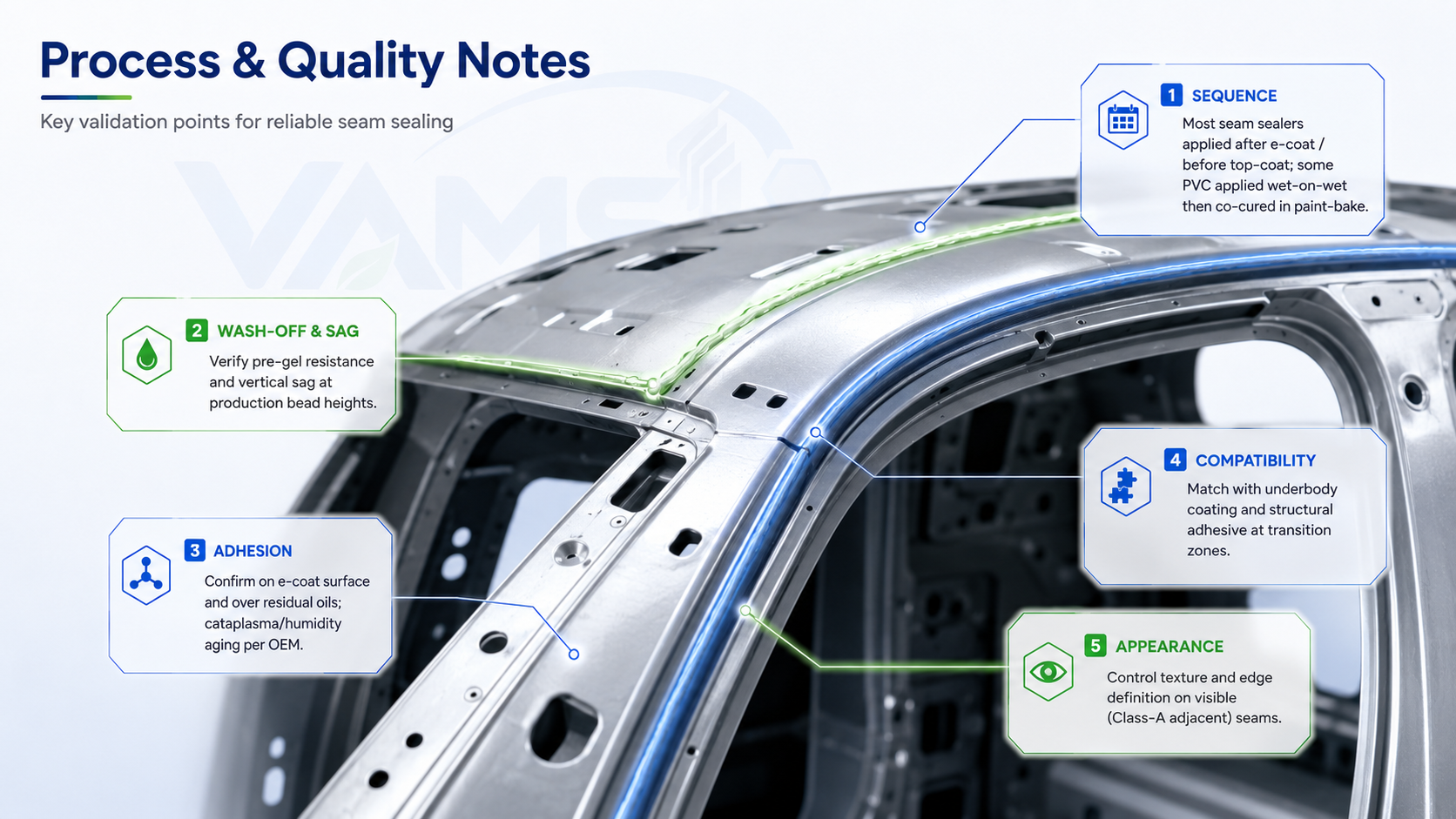
Process sequence, wash-off / sag control, adhesion and appearance
- Sequence: most seam sealers applied after e-coat / before top-coat; some PVC applied wet-on-wet then co-cured in paint-bake.
- Wash-off & sag: verify pre-gel resistance and vertical sag at production bead heights.
- Adhesion: confirm on e-coat surface and over residual oils; cataplasma/humidity aging per OEM.
- Compatibility: match with underbody coating and structural adhesive at transition zones.
- Appearance: control texture and edge definition on visible (Class-A adjacent) seams.
Common Defects
- Poor wetting on oily, dusty or improperly prepared seams
- Pinholes or voids that create water leak paths
- Bead discontinuity at seam starts, stops or overlaps
- Sagging or slump before cure or bake
- Cracking after bake, vibration or thermal cycling
- Poor paint compatibility or surface appearance defects
- Insufficient coverage at weld flanges, corners or seam ends
- Incorrect application method for vertical, overhead or robotic sealing areas
Why VAMS
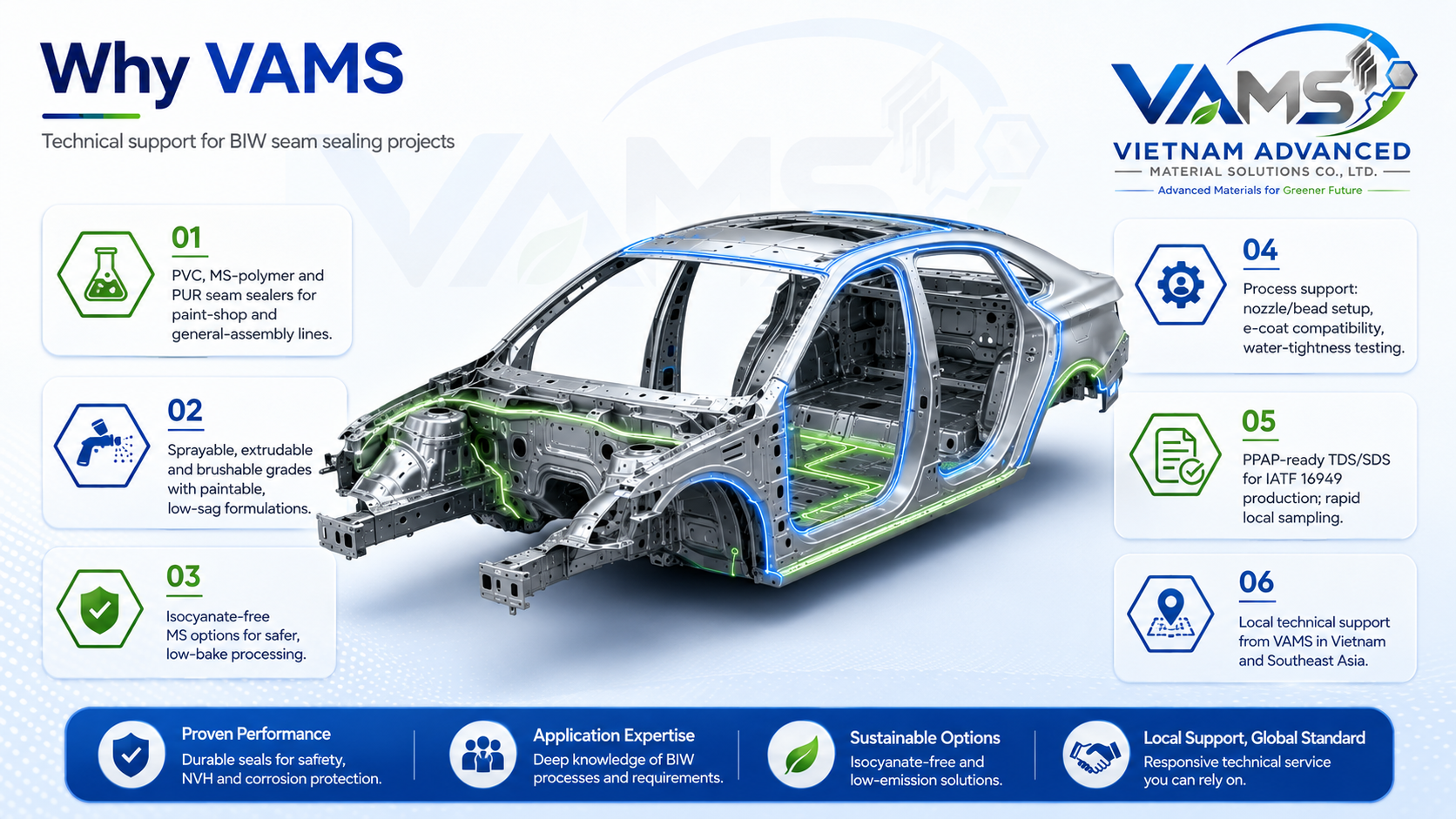
Why manufacturers choose VAMS seam sealing solutions
- PVC, MS-polymer and PUR seam sealers for paint-shop and general-assembly lines
- Sprayable, extrudable and brushable grades with paintable, low-sag formulations
- Isocyanate-free MS options for improved handling profile and low-bake processing requirements
- Process support: nozzle/bead setup, e-coat compatibility, water-tightness testing
- TDS/SDS and project documentation support for PPAP or customer approval for IATF 16949 production; local sampling coordination
Adhesives & Sealants for Body-in-White and General Assembly
Structural Adhesives for Body-in-White
Need help with seam sealing?
Tell us your seam type, application method, line speed and appearance requirements. VAMS can help recommend suitable seam sealers for your body shop.