
Potting Compounds — Materials & Applications
Epoxy, polyurethane and silicone encapsulation for electronics protection, dielectric isolation and thermal management
Values are typical reference ranges and may vary depending on resin chemistry, filler package, mix ratio, fill depth, substrate condition, cure profile, application geometry, operating environment and validation method.
Potting, or encapsulation, fully embeds a component or assembly in a cured resin to protect it against moisture, dust, vibration, shock, chemicals and electrical stress. The right potting compound should be selected based on voltage level, operating temperature, vibration exposure, chemical environment, thermal requirement, rework needs and production process. This guide compares epoxy, polyurethane and silicone systems and explains where each chemistry fits best.
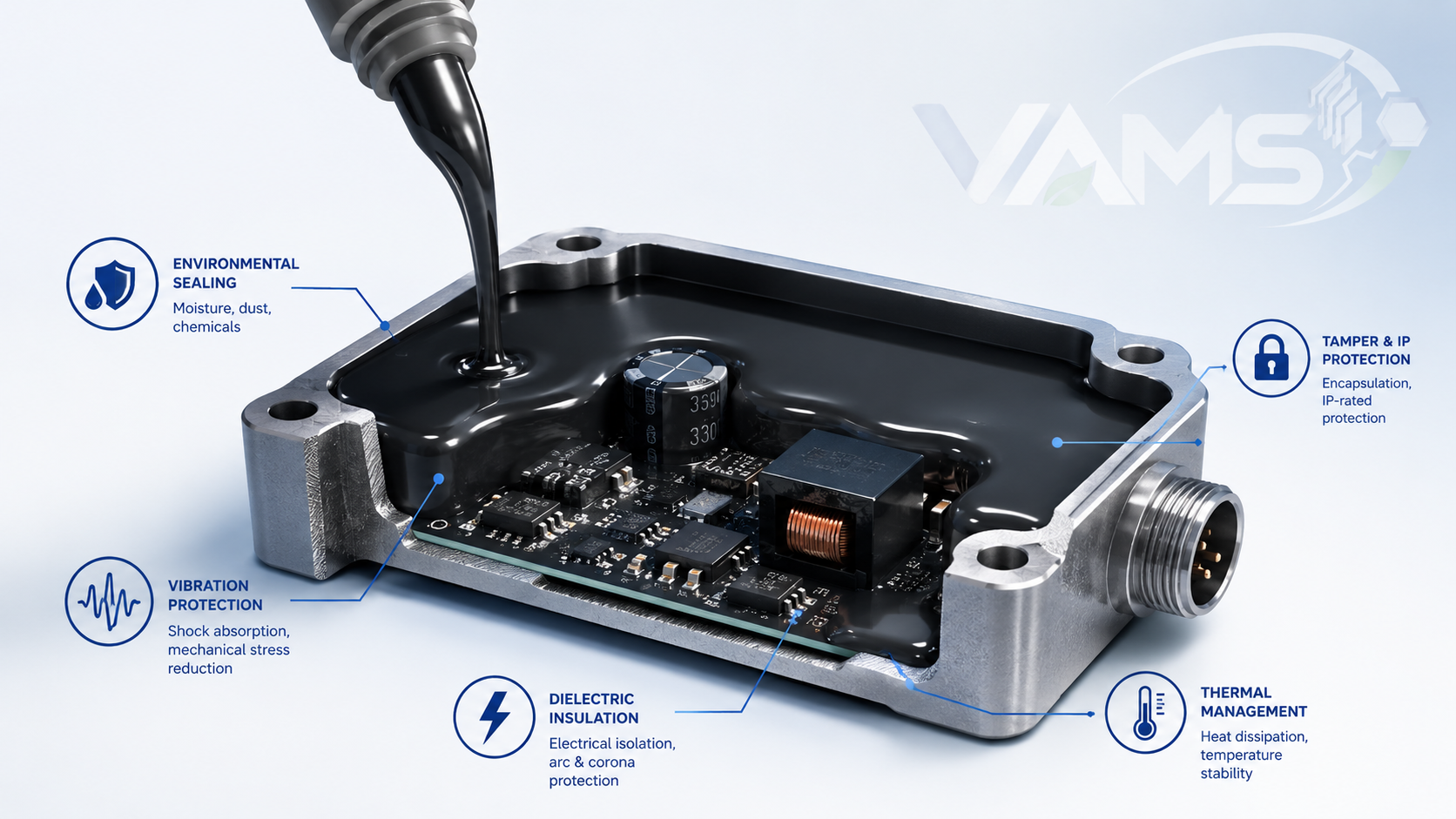
A potted assembly — component fully encapsulated in resin for environmental, mechanical and dielectric protection
What Potting Does
Potting differs from conformal coating: a coating is a thin surface film, while potting fills the entire housing/cavity around the component. That full encapsulation delivers several protections at once:
- Environmental sealing: blocks moisture, humidity, dust and chemicals (supports high IP ratings)
- Mechanical protection: absorbs shock and vibration, secures components and wires
- Dielectric isolation: insulates conductors, raises working voltage, prevents arcing/CAF
- Thermal management: thermally conductive grades pull heat from components to the housing
- Tamper / IP resistance: protects and obscures the assembly
Potting vs Conformal Coating vs Encapsulation
Choosing the right protection method depends on how much of the assembly must be covered, the dielectric and mechanical demands, and the need for reworkability.
| Protection Method | Typical Thickness / Coverage | Best For | Key Limitations |
|---|---|---|---|
| Conformal Coating | ~25–100 µm thin film on the board surface | Thin PCB surface protection against moisture, dust and corrosion | Limited mechanical reinforcement and gap filling |
| Potting | Full enclosure / cavity volume fill | Full volume filling, dielectric insulation, vibration protection and environmental sealing | Adds mass, may reduce reworkability and requires cure/process control |
| Encapsulation / Local Dam | Selective fill around specific components or zones | Selective protection around sensitive components or high-voltage areas | Requires precise dispense control and design validation |
Chemistry Selection
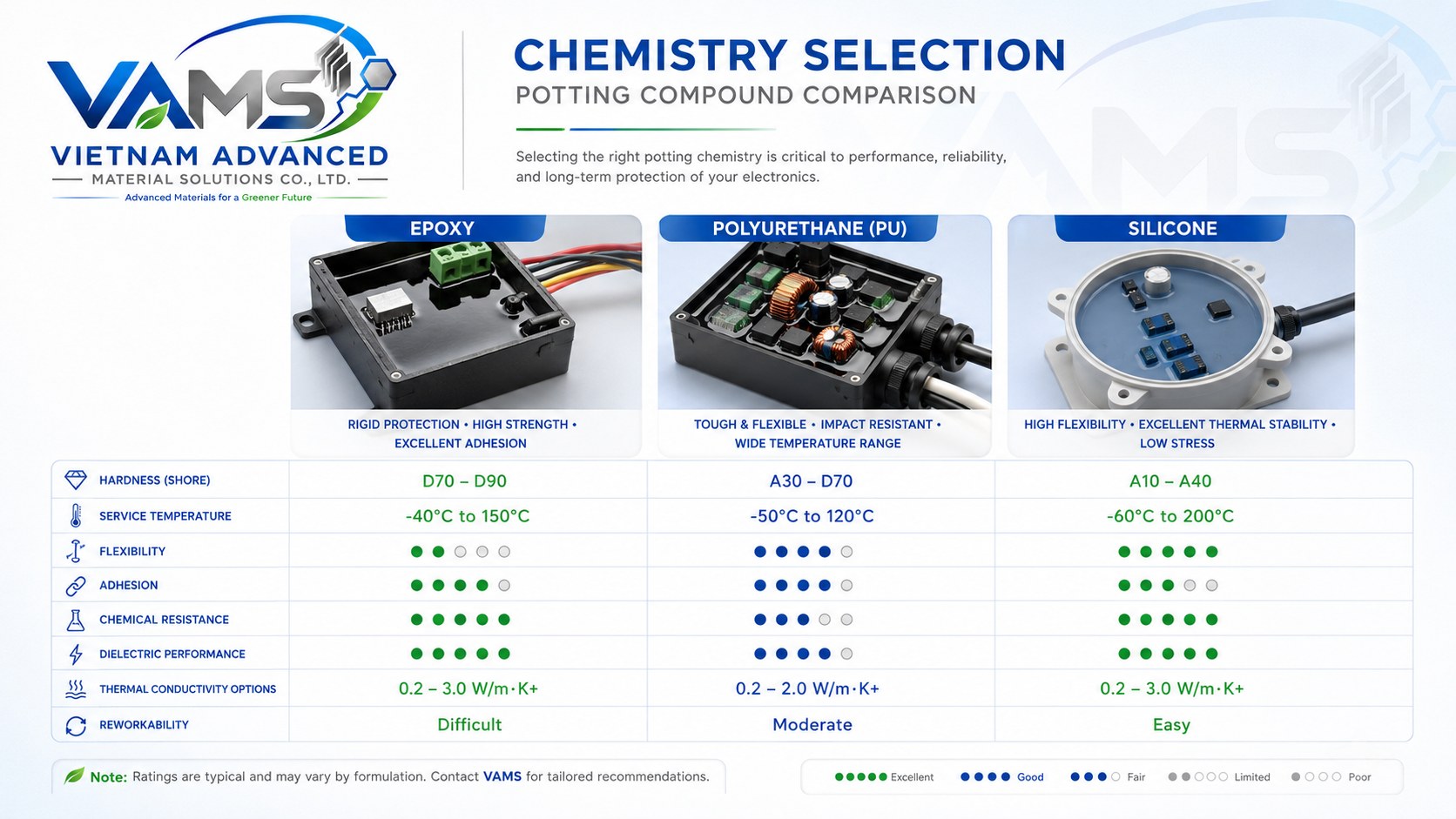
Epoxy, polyurethane and silicone potting — comparing hardness, temperature range and flexibility
Epoxy Potting
Highest mechanical strength, chemical resistance and adhesion. Rigid, hard, dimensionally stable. Commonly used where maximum protection and structural rigidity matter — but limited flexibility and harder to rework.
Polyurethane (PU) Potting
Balanced flexibility and protection. Good vibration/shock damping and low-temperature toughness. A versatile mid-ground for many electronics; sensitive to moisture during cure.
Silicone Potting
Widest temperature range and best thermal-cycling/stress relief. Soft, flexible, reworkable, low stress on delicate components. Commonly used for high-temperature zones and thermally cycled assemblies; lower mechanical strength and adhesion.
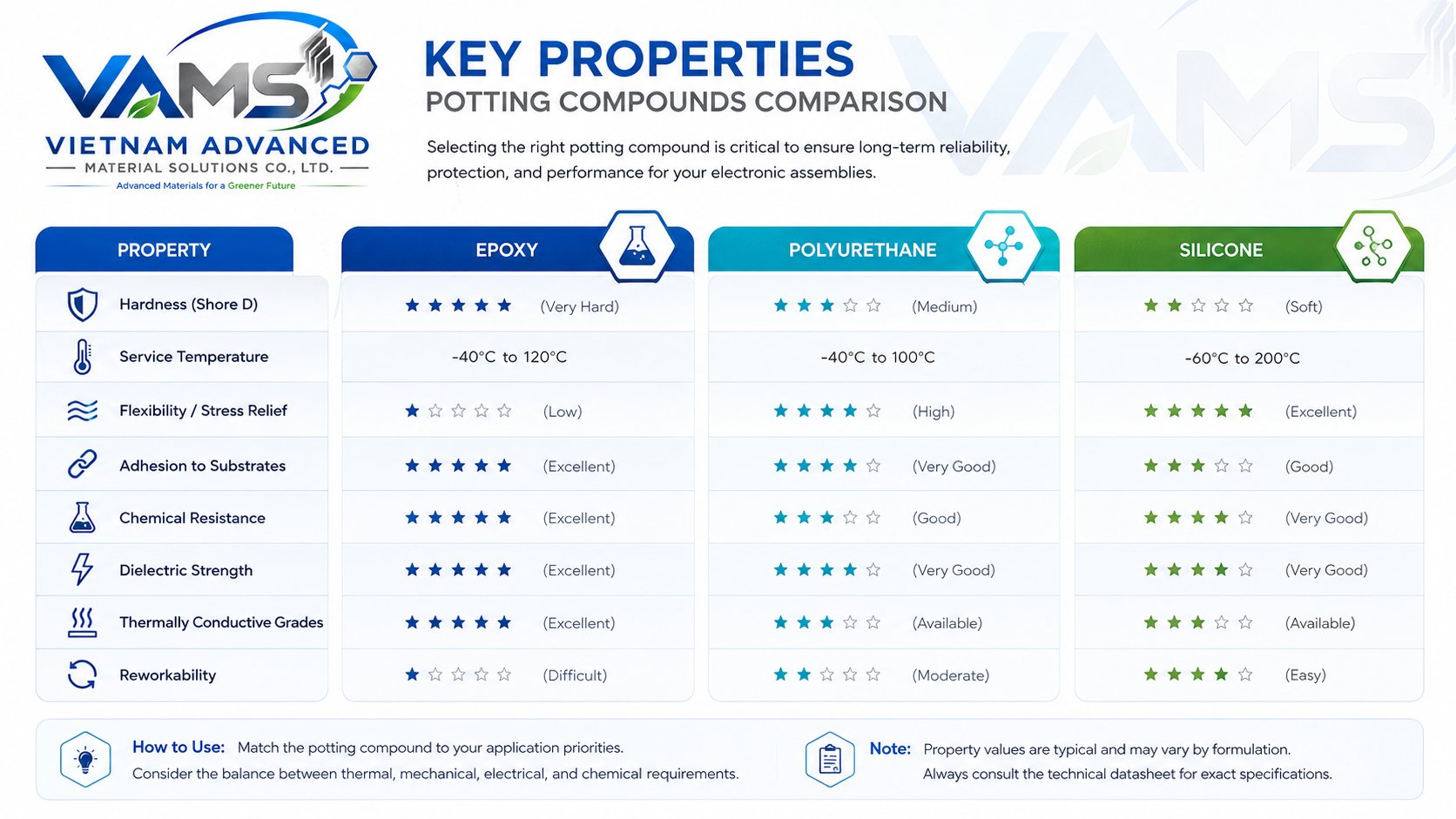
Key Properties
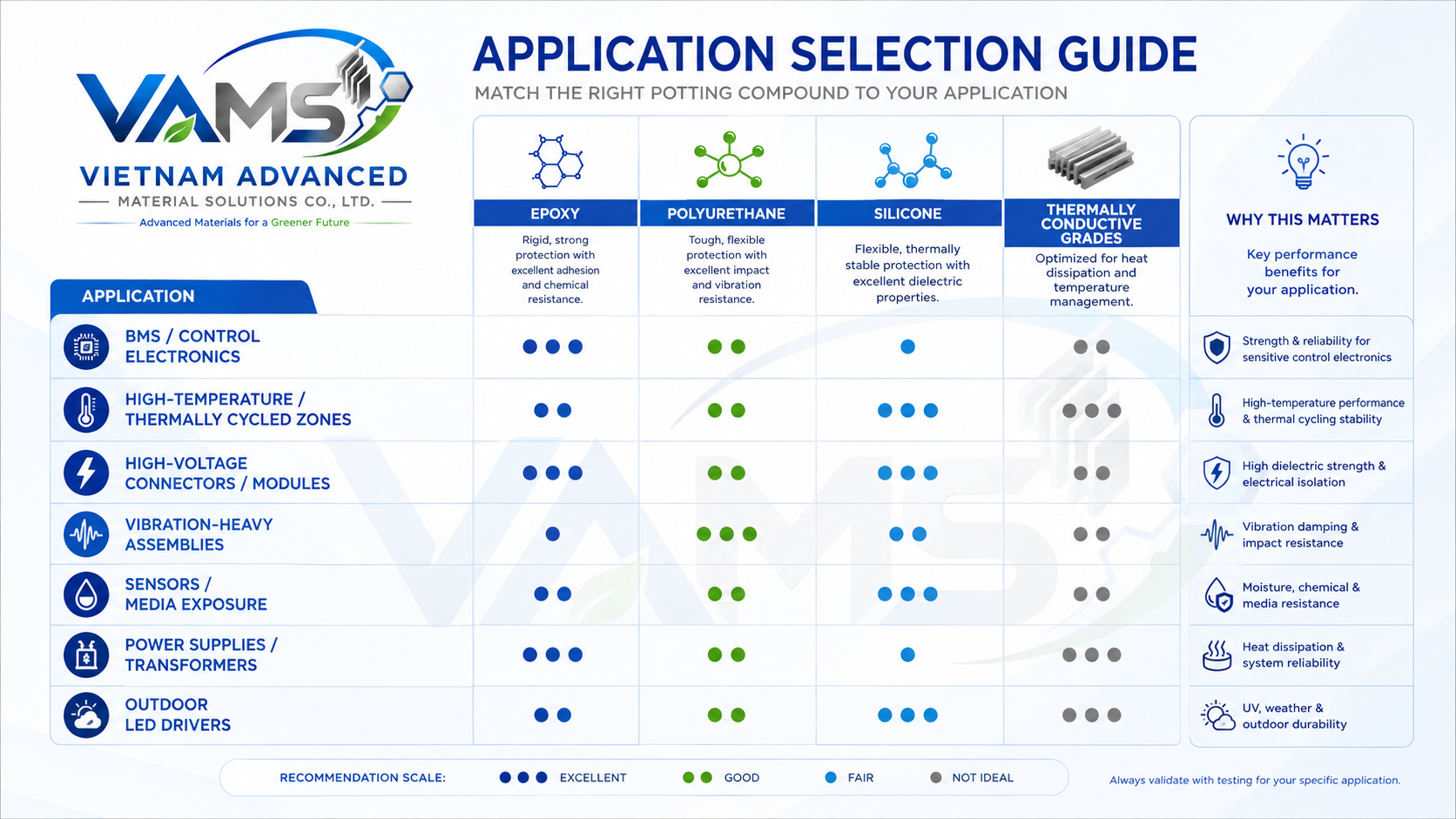
Key potting properties — hardness, temperature, dielectric strength and thermal conductivity
| Property | Epoxy | Polyurethane | Silicone |
|---|---|---|---|
| Hardness | Hard (Shore D) | Medium (Shore A–D) | Soft (Shore A / 00) |
| Service temperature | −40 to +150°C | −50 to +120°C | −50 to +200°C |
| Flexibility / stress relief | Low | Medium–high | High |
| Adhesion | Excellent | Good | Fair (primer often needed) |
| Chemical resistance | Excellent | Good | Good (polar solvents vary) |
| Dielectric strength | > 15–20 kV/mm | > 10–20 kV/mm | > 10–20 kV/mm |
| Thermally conductive grades | Up to ~1–3 W/m·K | Up to ~1–2 W/m·K | Up to ~1–3 W/m·K |
| Reworkability | Difficult | Moderate | Good |
Indicative ranges across product families. Refer to the specific product TDS for certified, grade-level values.
Suitable Applications
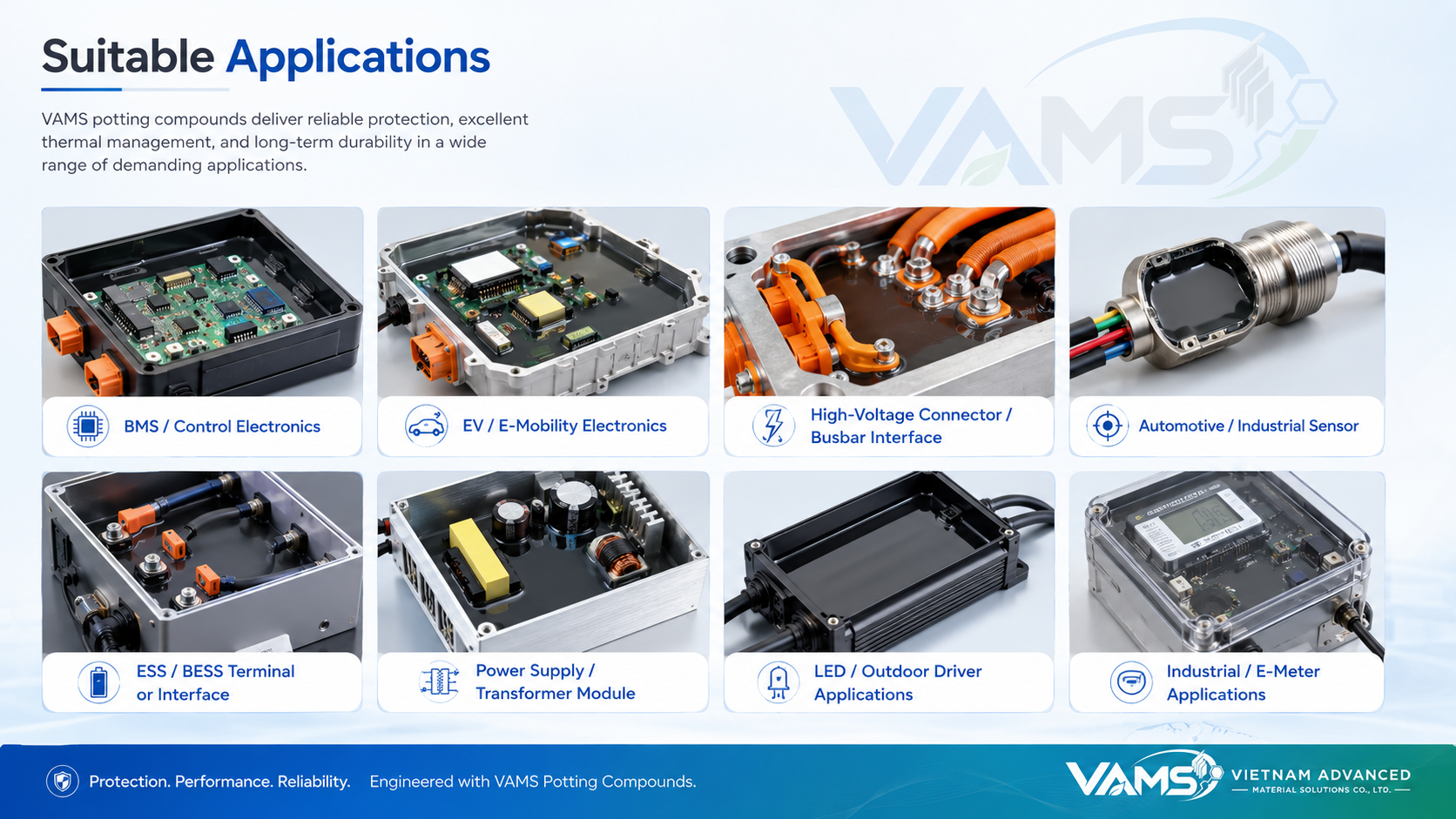
Typical potting applications across electronics, EV, high-voltage, sensors, ESS and power supplies
Potting is used wherever an electronic or electrical assembly must survive a harsh environment. Typical applications:
- BMS & control electronics: vibration, moisture and dielectric protection for battery management boards and connectors
- EV / e-mobility: sensors, control units, junction boxes and on-board electronics exposed to vibration and fluids
- High-voltage components: connectors, busbar joints and HV modules needing dielectric isolation and arc prevention
- Sensors & transducers: automotive and industrial sensors needing media/IP sealing and shock resistance
- Energy storage (ESS/BESS): terminal blocks and HV interfaces requiring isolation and environmental sealing
- Power supplies & converters: transformers, inductors and SMPS modules for thermal management and isolation
- LED & outdoor electronics: drivers and modules needing UV/weather and moisture protection
- Industrial & e-meter: tamper resistance, IP sealing and long-term reliability
Application Selection Guide
Selecting the right potting chemistry by application requirement
| Application | Typical Chemistry Options | Why |
|---|---|---|
| BMS / control electronics | Epoxy or PU | Rigid protection (epoxy) or vibration damping (PU) |
| High-temperature / thermally cycled zones | Silicone | Wide temp range, low stress on components |
| High-voltage connectors / modules | Epoxy or silicone | High dielectric strength; silicone for thermal cycling |
| Vibration-heavy assemblies (e-scooter, EV) | Polyurethane | Flexible, absorbs shock and vibration |
| Sensors / media exposure | PU or epoxy | Chemical resistance and IP sealing |
| Power supplies / transformers | Epoxy (TC) or silicone (TC) | Thermally conductive isolation |
| Outdoor / LED drivers | PU or silicone | UV / weather durability and flexibility |
Epoxy = maximum strength & chemical resistance
Polyurethane = flexibility & vibration
Silicone = high temperature & thermal cycling
Add a thermally conductive (TC) grade when heat removal is required.
Potting chemistry should not be selected by resin family alone. Final selection should balance dielectric strength, thermal performance, hardness, adhesion, chemical resistance, reworkability, fill depth, exotherm, cure schedule and production process.
Design & Process Notes
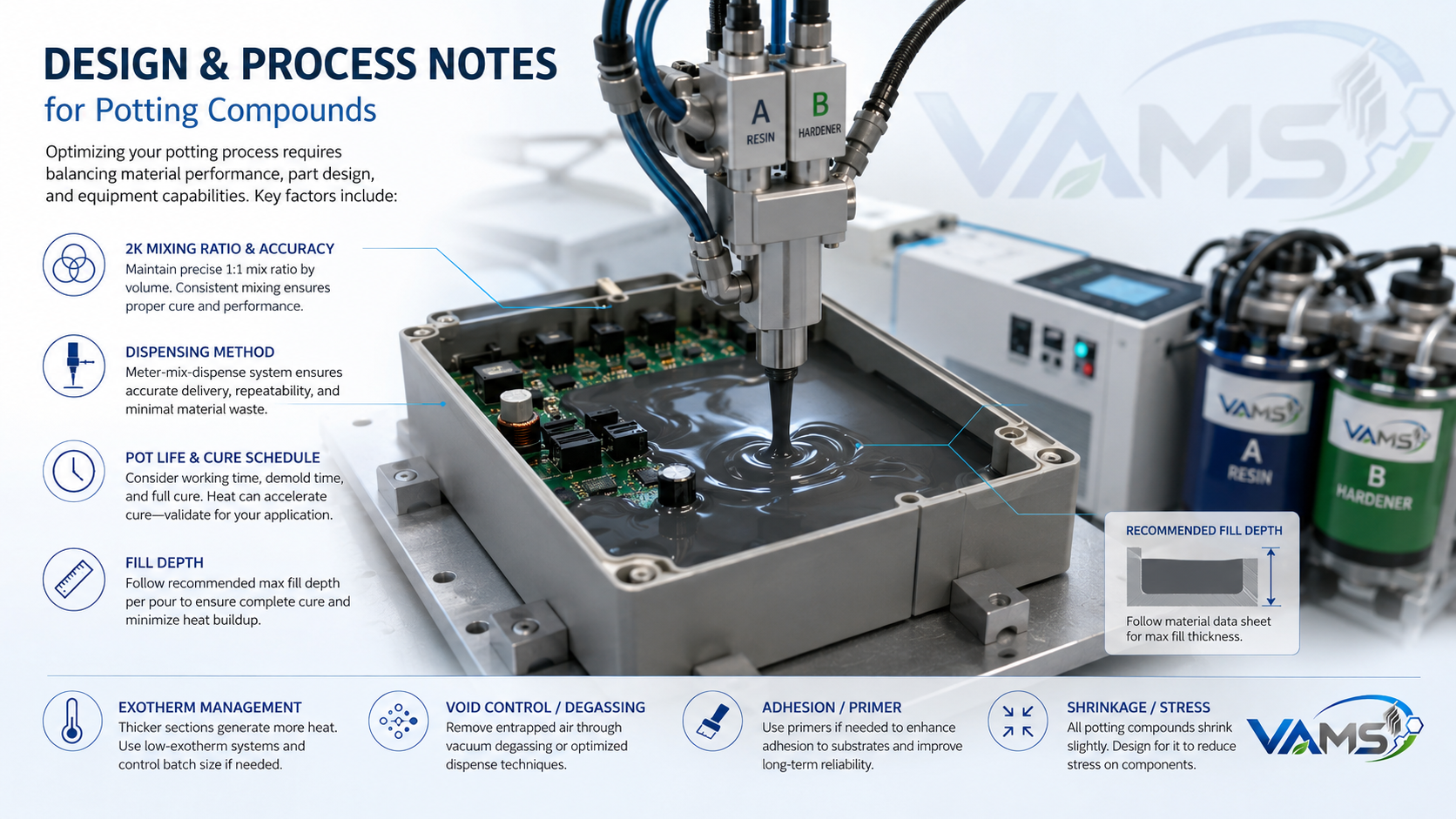
Potting process — mix, dispense / vacuum fill, exotherm management and cure
| Parameter | Typical Window / Note |
|---|---|
| System | Mostly 2K (mix ratio by weight/volume); some 1K |
| Dispensing | Hand-mix, meter-mix-dispense (MMD); vacuum potting for void-free fill |
| Pot life / cure | Tunable; RT or heat-accelerated (60–100°C) |
| Fill depth & exotherm | Thick sections raise exotherm — manage with filled grades / staged pours |
| Voids | Degas / vacuum to avoid voids that lower dielectric & thermal performance |
| Adhesion | Clean surfaces; primer for silicone on some substrates |
| Shrinkage / stress | Choose flexible grades for delicate parts to limit cure stress |
Why VAMS
- Epoxy, polyurethane and silicone potting systems — standard and thermally conductive grades
- Flame-retardant and high-dielectric options, including UL 94 V-0 grades depending on chemistry and product grade, for high-voltage and reliability-critical assemblies
- Material selection by application, temperature, voltage, vibration and rework needs
- Process support: mix ratio, MMD/vacuum potting, exotherm and void control, adhesion testing
- TDS/SDS and project documentation support for PPAP or customer approval; local sampling coordination across Vietnam & Southeast Asia
PCB & Power Electronics Material Solutions
Battery System Material Solutions
E-motor System Material Solutions
Thermal Interface Materials (TIM)
Need help selecting a potting compound?
Tell us your part geometry, thermal and electrical requirements, environment and process. VAMS can help recommend a suitable epoxy, polyurethane or silicone potting system for your application.