
Conformal Coating, Potting and Thermal Materials for PCB & Power Electronics
Conformal coating, HV potting and thermal control for EV, ESS and industrial electronics
Values are typical reference ranges and may vary depending on material chemistry, thickness, substrate condition, curing process, application method and validation standard.
Power electronics are the control core of EV, inverter and energy storage systems. They are exposed to moisture, contamination, vibration, dielectric stress and heat, so material selection directly affects long-term reliability. Conformal coatings shield PCBs from moisture and contamination, potting compounds insulate and protect high-voltage assemblies, and thermal interface materials pull heat out of power modules. VAMS supplies all three, validated for demanding automotive and industrial electronics.
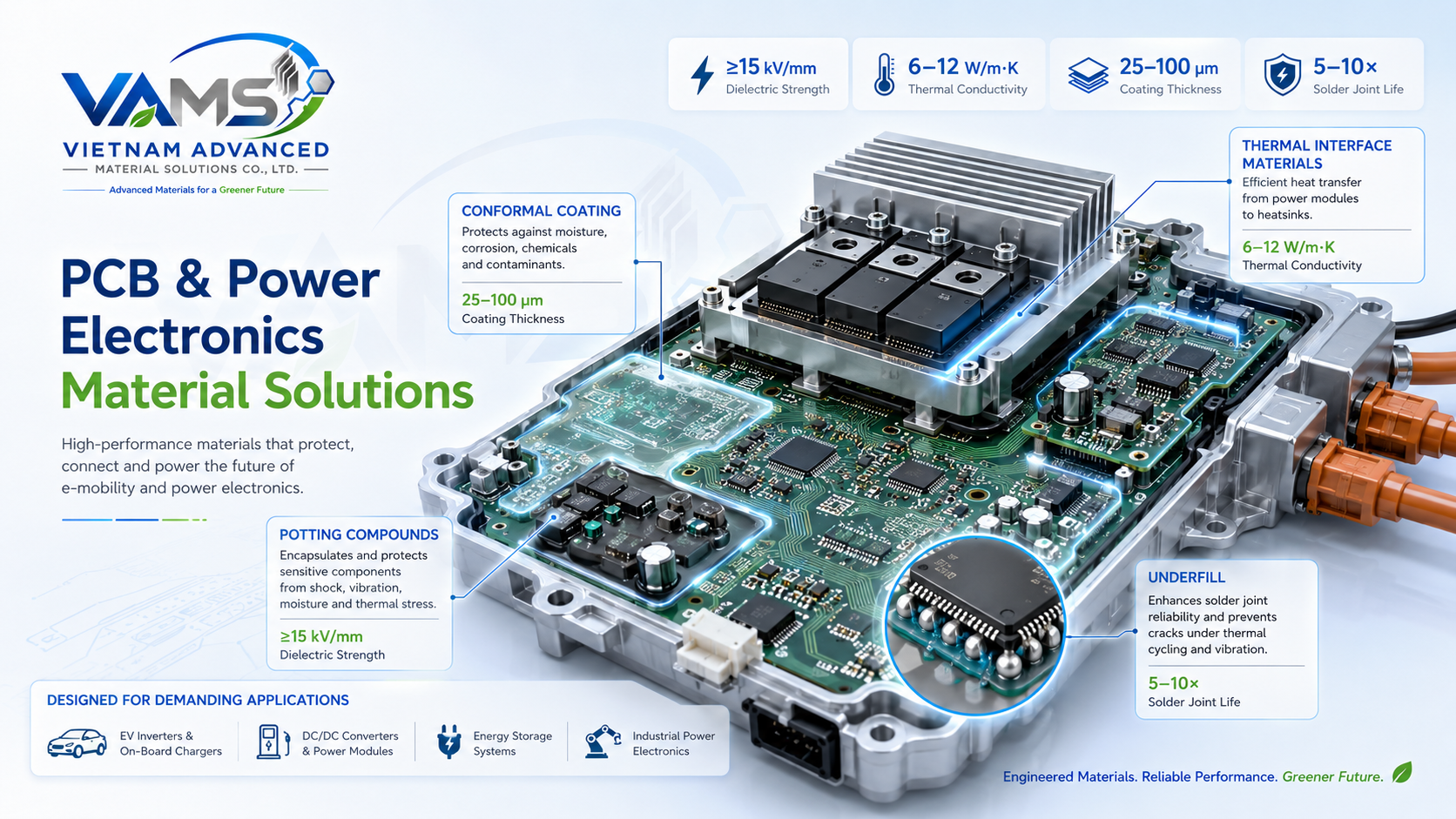
VAMS supplies conformal coatings, potting compounds, and thermal interface materials covering every protection requirement for PCBs and power electronics
Three Failure Modes — Three Material Answers
Electronics assemblies fail in three main ways: moisture and contamination corrode tracks and cause leakage between conductors; high voltage arcs across insufficient insulation; and heat from power devices accumulates until junctions exceed their limits. Each failure mode has a dedicated material answer.
VAMS supplies conformal coatings for environmental protection, potting compounds for dielectric isolation and mechanical protection, and thermal interface materials for power-device cooling — covering the full electronics protection stack from signal PCBs to high-power inverters.
- Moisture / corrosion / contamination → conformal coating
- Dielectric stress / vibration / mechanical shock → potting or encapsulation
- Heat / high power density → TIM, thermal pad or gap filler
Conformal Coating for PCB Protection
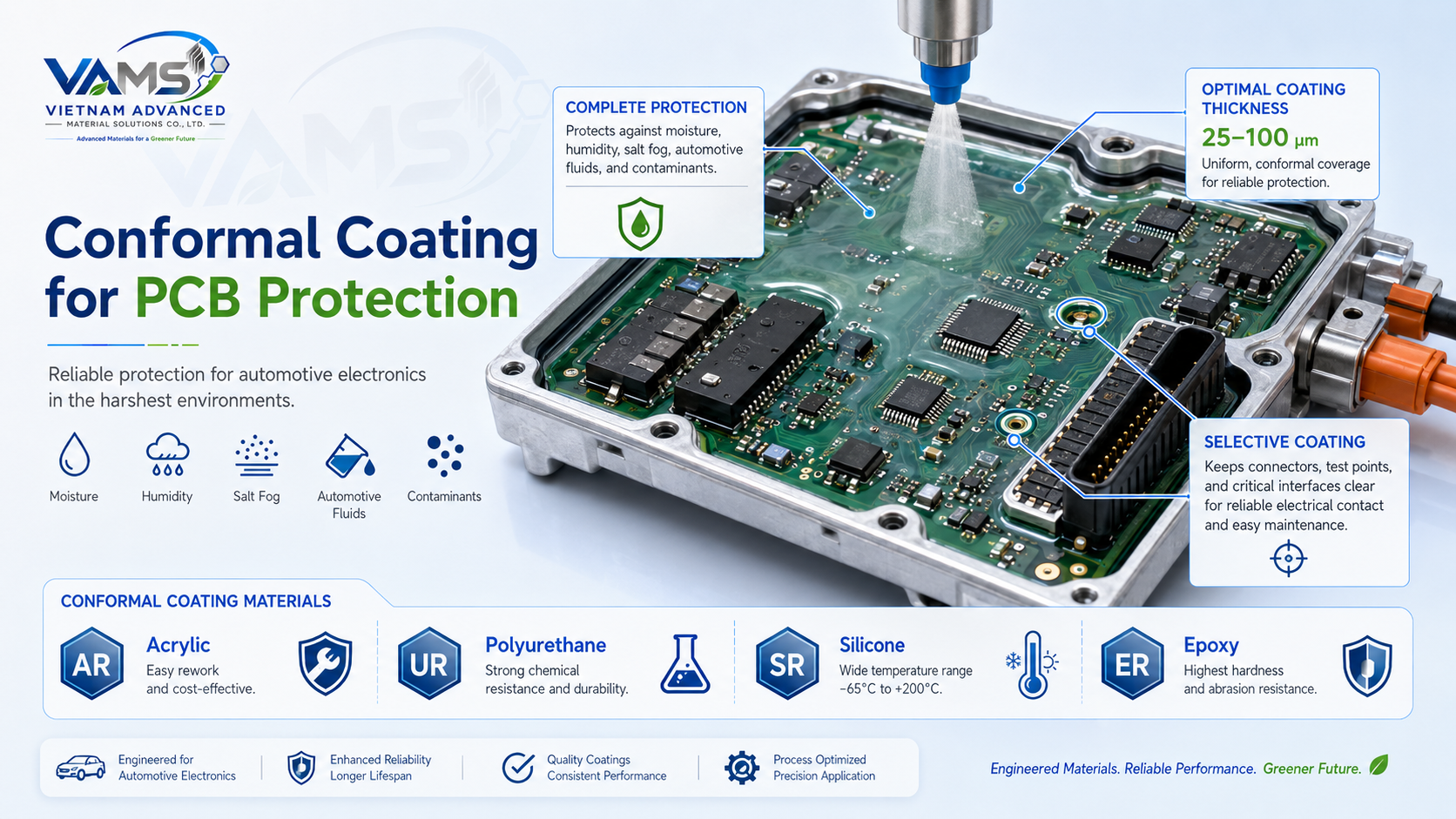
A thin conformal film (25–100 µm) protects PCBs against moisture, dust, and chemicals — applied by selective, dip, or spray coating
A conformal coating is a thin protective film (typically 25–100 µm) that follows the contours of a populated PCB, sealing it against moisture, dust, condensation, and chemical contamination — the leading causes of field failure in automotive and industrial electronics. VAMS offers a full chemistry range so the coating can be matched to the operating environment:
Acrylic (AR)
Easy to apply and rework, fast drying — a cost-effective choice for general-purpose protection in moderate environments.
Polyurethane (UR)
Excellent chemical and abrasion resistance for harsh chemical and solvent exposure.
Silicone (SR)
Wide temperature range and flexibility — ideal for high-temperature zones and thermal-cycling environments.
Epoxy (ER)
Hard, durable film with strong moisture and abrasion resistance where maximum protection is needed.
Potting for High-Voltage Electronics
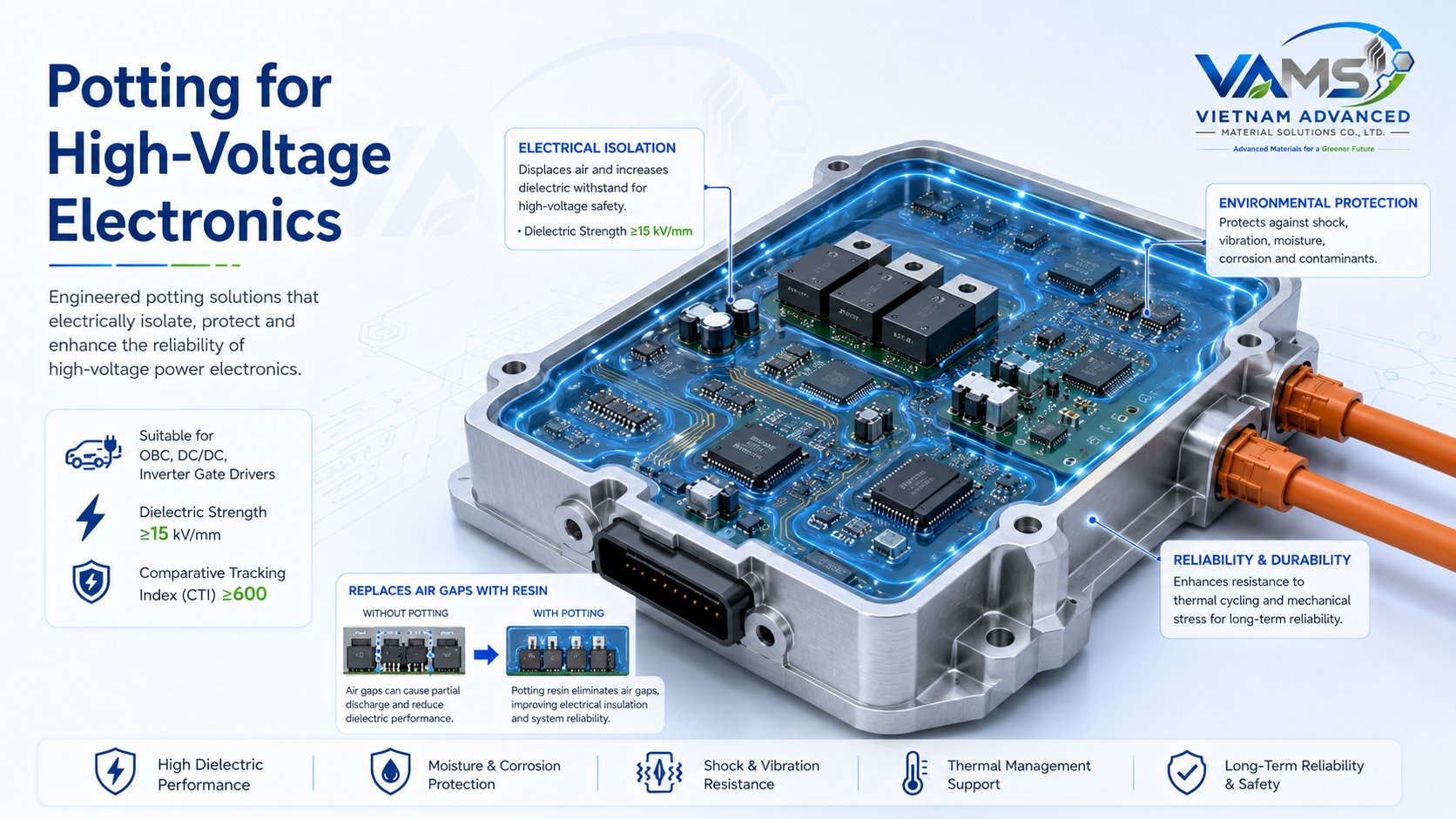
Engineered potting encapsulates high-voltage assemblies for dielectric isolation, vibration damping, and full environmental sealing
Potting fully encapsulates a high-voltage assembly in a cured resin, providing dielectric isolation between conductors, mechanical protection against shock and vibration, and a complete barrier against moisture and contaminants. VAMS supplies epoxy, polyurethane, and silicone potting systems selected for dielectric strength, thermal class, and flexibility:
Epoxy: Highest mechanical strength and chemical resistance — for rigid, protected assemblies
Polyurethane: Balanced flexibility and protection for vibration environments
Silicone: Best thermal-cycling and high-temperature performance, soft and reworkable
Thermal Interface Materials for Power Modules
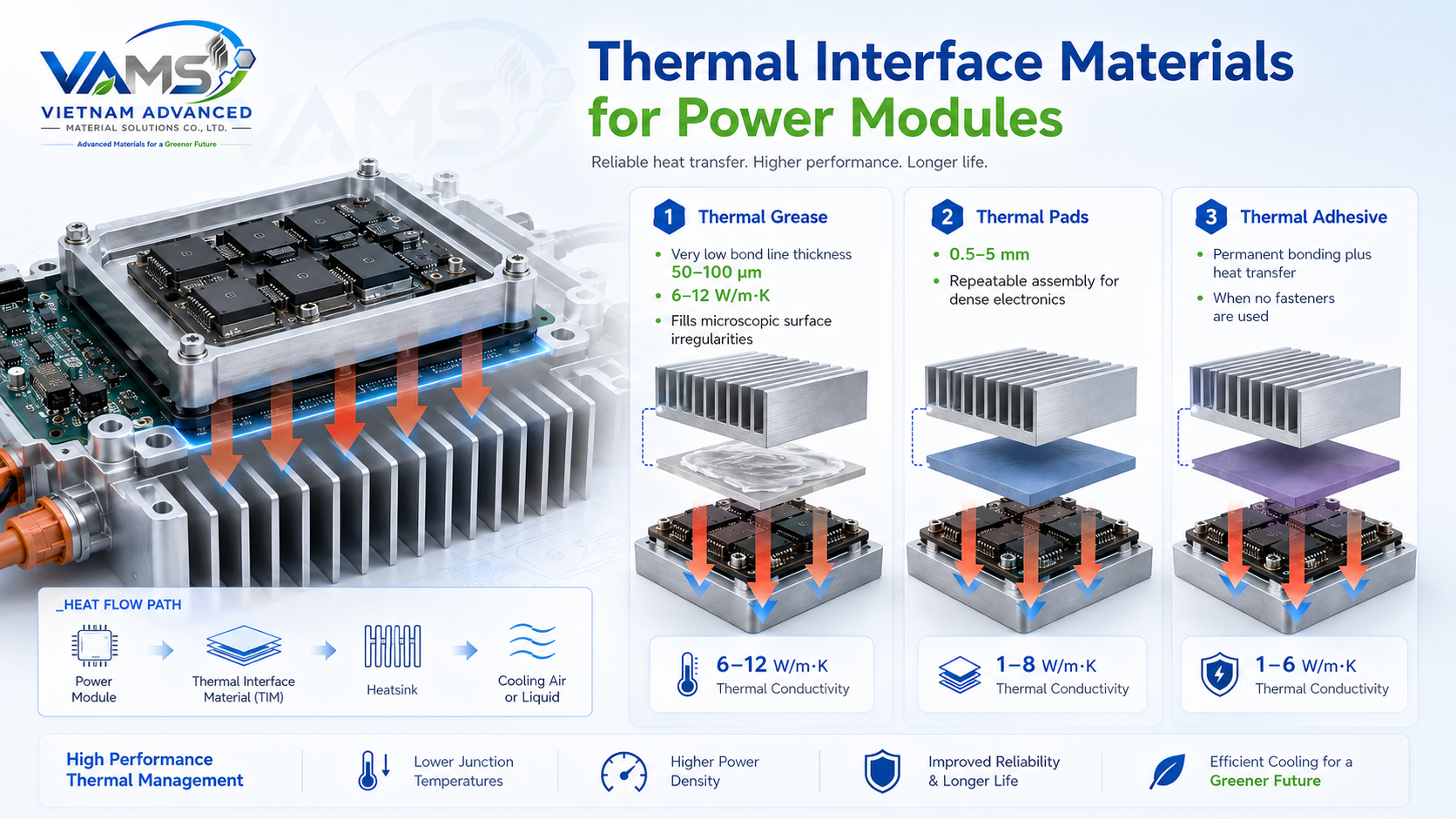
Thermal grease, pads, and gap fillers move heat from power devices to the heat sink — keeping junction temperatures within limits
Power devices — IGBTs, MOSFETs, and SiC modules — generate intense, concentrated heat that must reach the heat sink before junction temperatures exceed their limits. VAMS thermal interface materials fill the microscopic air gaps between device and heat sink with a continuous, high-conductivity path:
Thermal Grease
Lowest thermal resistance for high-performance cooling where a thin, conformable bond line is required.
Thermal Pads
Repeatable assembly, electrically insulating options, and clean to handle — ideal for production lines.
Thermal Gap Fillers
Conform to large tolerances and uneven surfaces between multiple devices and a shared heat sink.
PCB & Power Electronics Material Summary
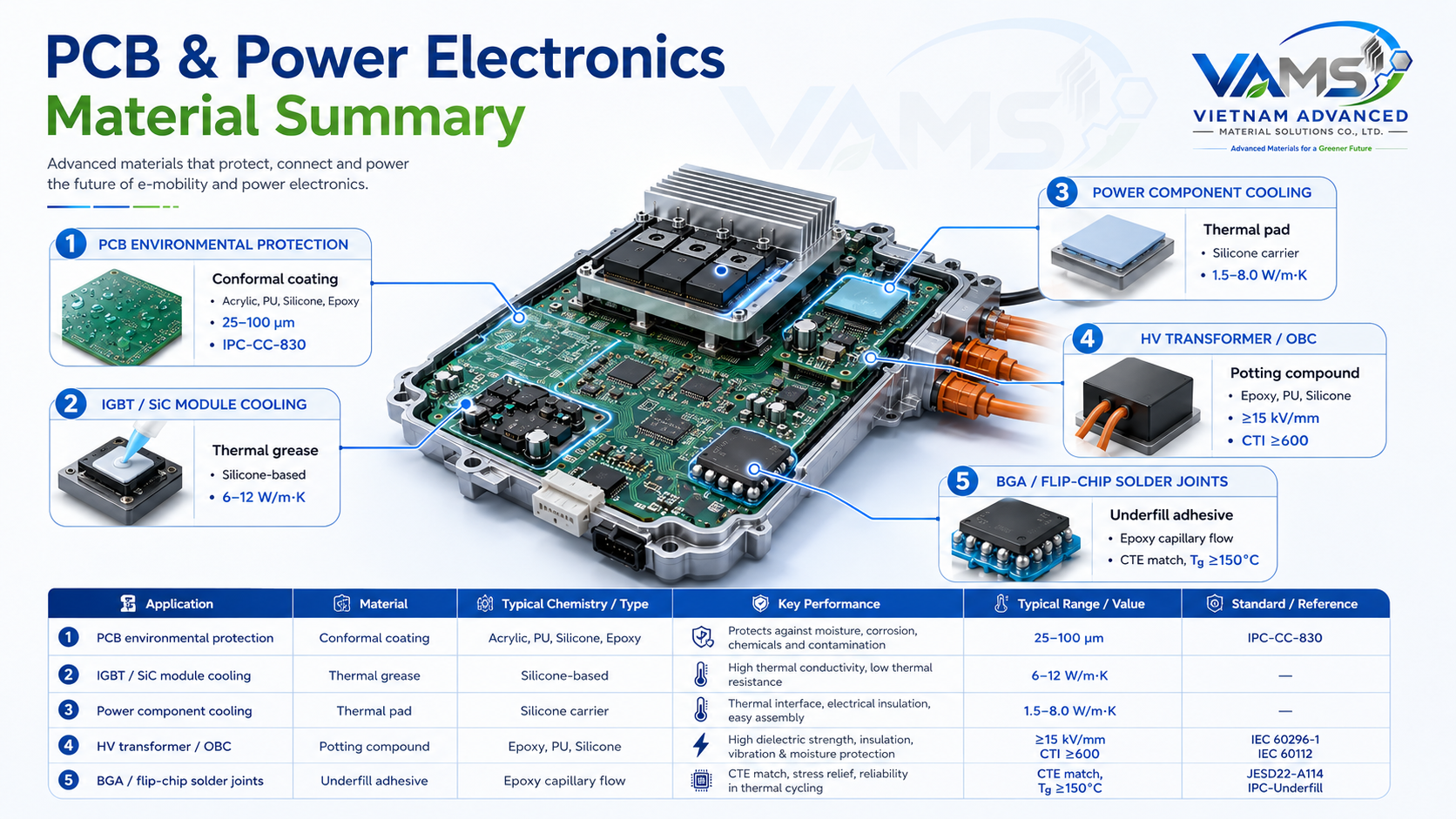
VAMS material recommendations mapped to each application, with function and key property at a glance
| Application | Material Solution | Function | Key Property |
|---|---|---|---|
| Signal & control PCBs | Conformal coating (AR/UR/SR) | Moisture & contamination protection | 25–100 µm film, IPC-CC-830 |
| High-voltage assemblies | Epoxy / PU / silicone potting | Dielectric isolation, sealing | 20–70+ kV/mm dielectric |
| Power modules (IGBT/SiC) | Thermal grease / pad / gap filler | Heat transfer to heat sink | 6–12 W/m·K |
| Connectors & terminals | RTV silicone sealant | IP sealing, high-temp stability | –40°C to +200°C |
| Heat-sensitive components | Soft gap filler | Tolerance absorption, cooling | Low compression force |
VAMS Electronics Material Expertise
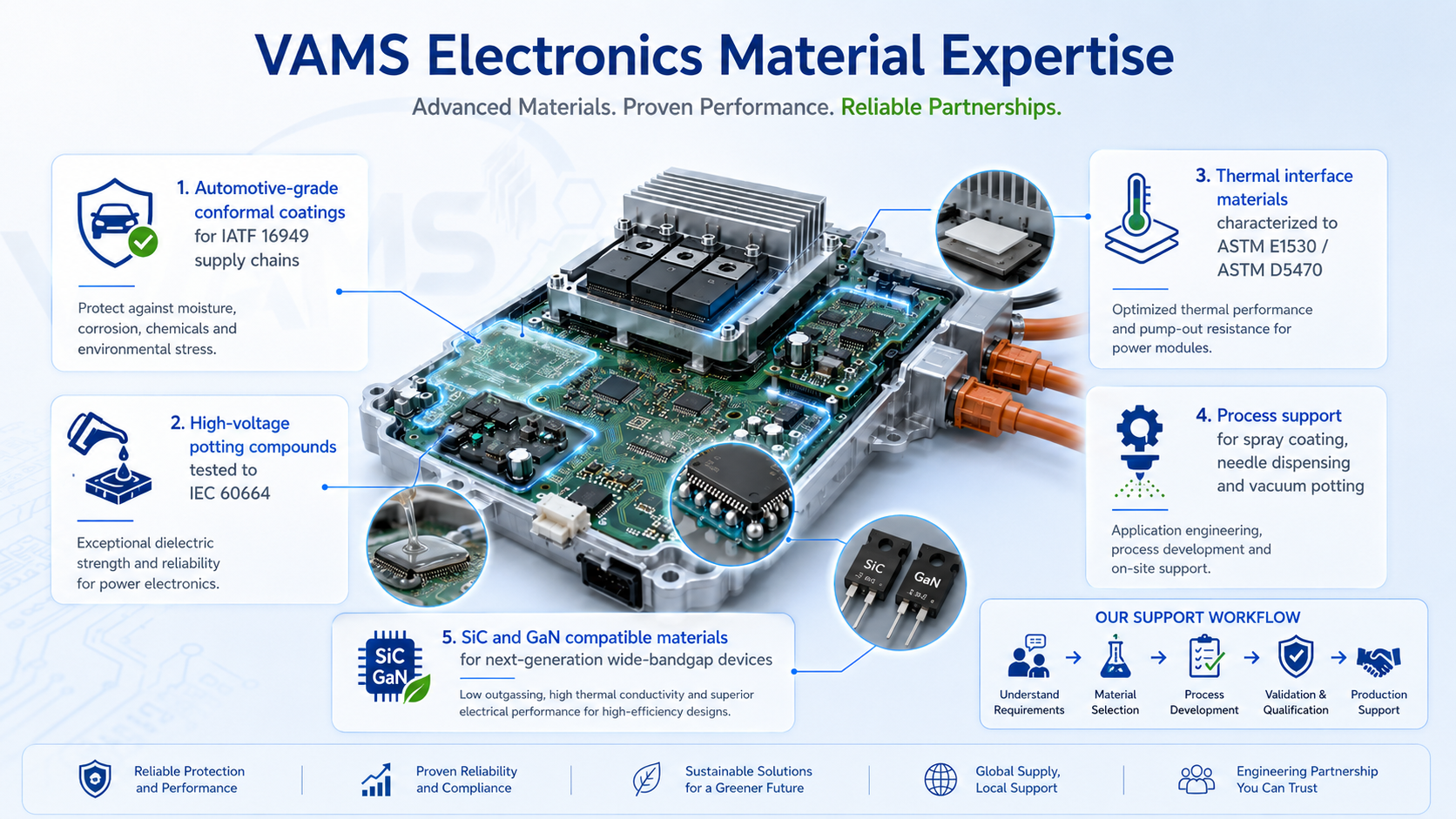
Automotive-oriented materials, application-oriented options, and reliable partnership — VAMS supports electronics teams from design to production
- Automotive-oriented conformal coating, potting and thermal material options for demanding electronic assemblies
- Material selection based on operating environment, voltage class, and thermal load
- Process support for selective, dip, and spray coating as well as automated potting
- SI, EV, and ESS-compatible materials for signal, high-voltage, and power applications
- Reliable supply and rapid sampling for prototype validation and production sign-off
Thermal Interface Materials (TIM)
Thermal Pads Selection Guide
Potting Compounds Guide
Battery System Material Solutions
Need help protecting your PCB or power module?
Tell us your operating environment, voltage, thermal load and process. VAMS can help recommend suitable conformal coatings, potting compounds and thermal interface materials for your electronics.