
Structural Adhesives for Body-in-White
Crash-durable structural bonding for lightweight EV Body-in-White design
Values are typical reference ranges and may vary depending on adhesive grade, substrate, joint design, surface condition, curing profile, application method and OEM validation standard.
Structural adhesives supplement spot welds with a continuous bond line, helping improve body stiffness, reduce localized stress concentration and distribute crash energy more evenly across the joint. This guide summarizes chemistries, mechanical data, substrate compatibility and application parameters for BIW structural bonding.
Application Zones
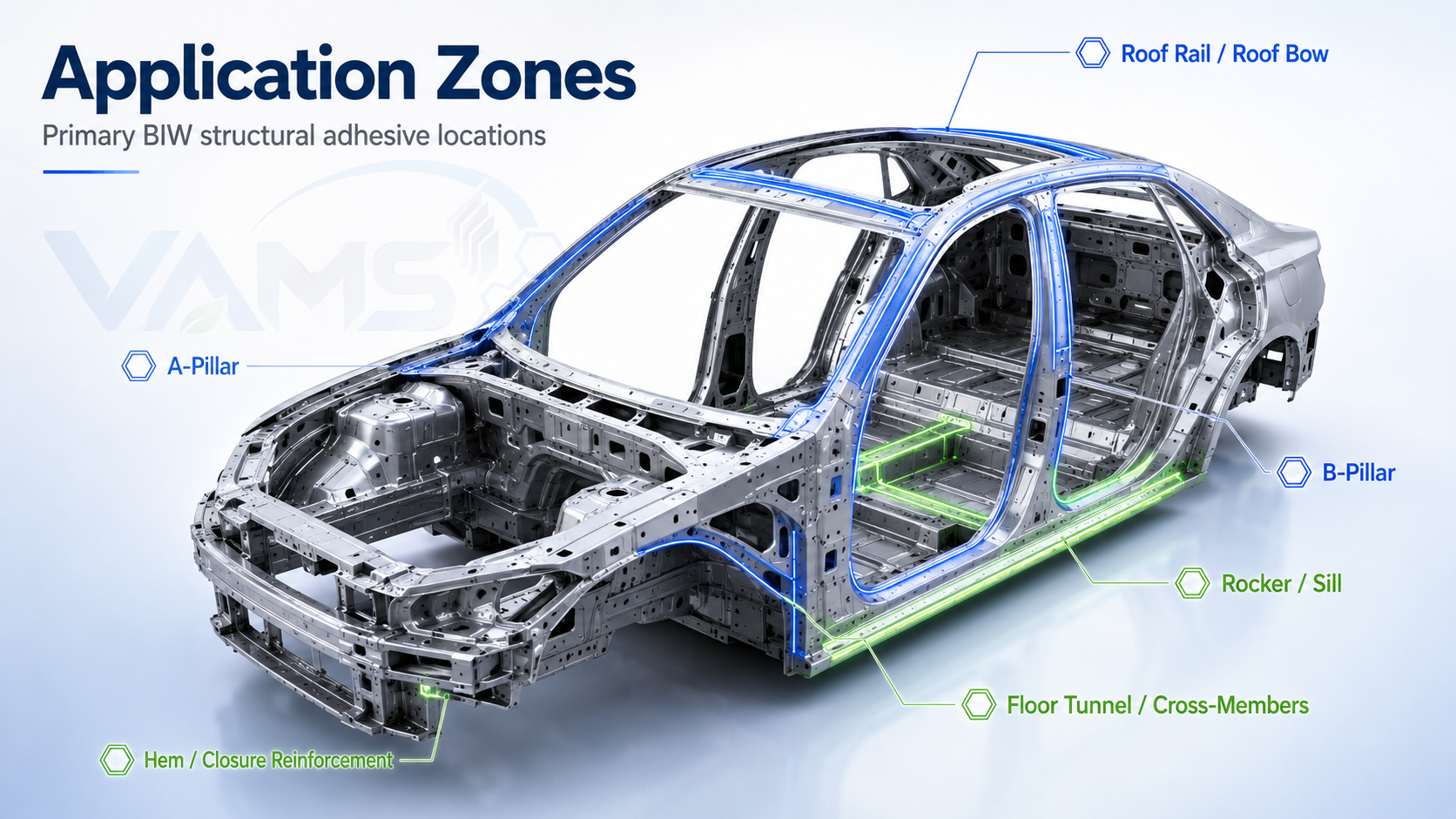
Primary BIW structural adhesive locations — pillars, roof rails, rockers, floor tunnel and closures
Structural adhesive is applied as a continuous bead along load-bearing joints, then cured during the paint-bake (e-coat) oven cycle. Primary BIW zones:
- A-pillar / B-pillar: frontal and side-impact load path integrity
- Roof rails & roof bow: rollover stiffness, roof crush resistance
- Rocker / sill: torsional rigidity; critical with floor-mounted battery
- Floor tunnel & cross-members: load distribution and NVH stiffening
- Hem & closure reinforcements: weld-bonding to reduce spot count
Chemistry & Type Selection
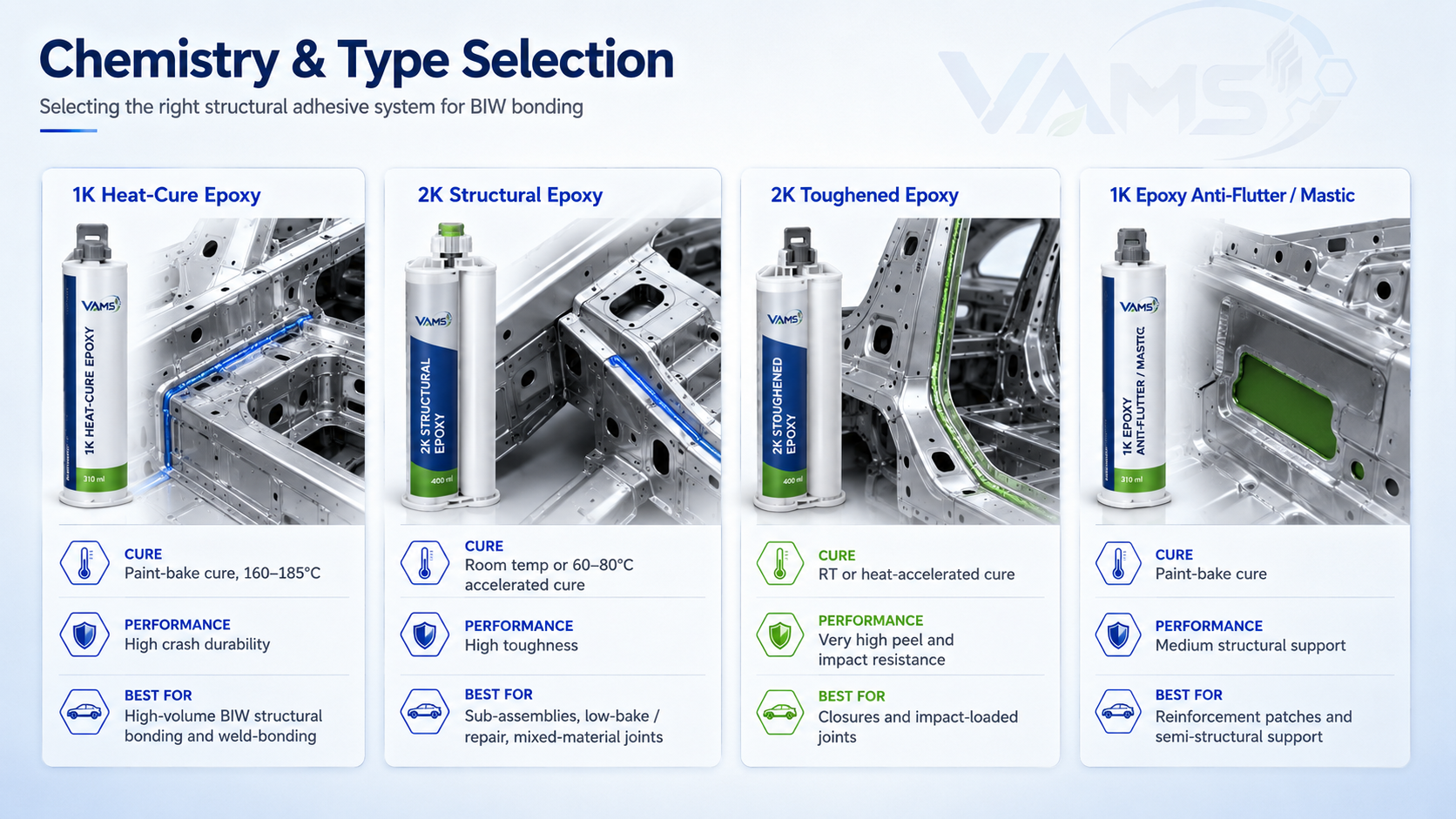
1K heat-cure and 2K epoxy chemistries matched to BIW bonding requirements
| Type | Cure | Toughness | Best For |
|---|---|---|---|
| 1K Heat-Cure Epoxy | Paint-bake, 160–185°C | High (crash-durable) | High-volume BIW structural bonding, weld-bonding |
| 2K Structural Epoxy | RT or 60–80°C accel. | High | Sub-assemblies, low-bake / repair, mixed-material |
| 2K Toughened Epoxy | RT or heat accel. | Very high peel/impact | Hood/trunk, closures, impact-loaded joints |
| 1K Epoxy (anti-flutter/mastic) | Paint-bake | Medium | Reinforcement patches, semi-structural support |
Typical Mechanical Properties
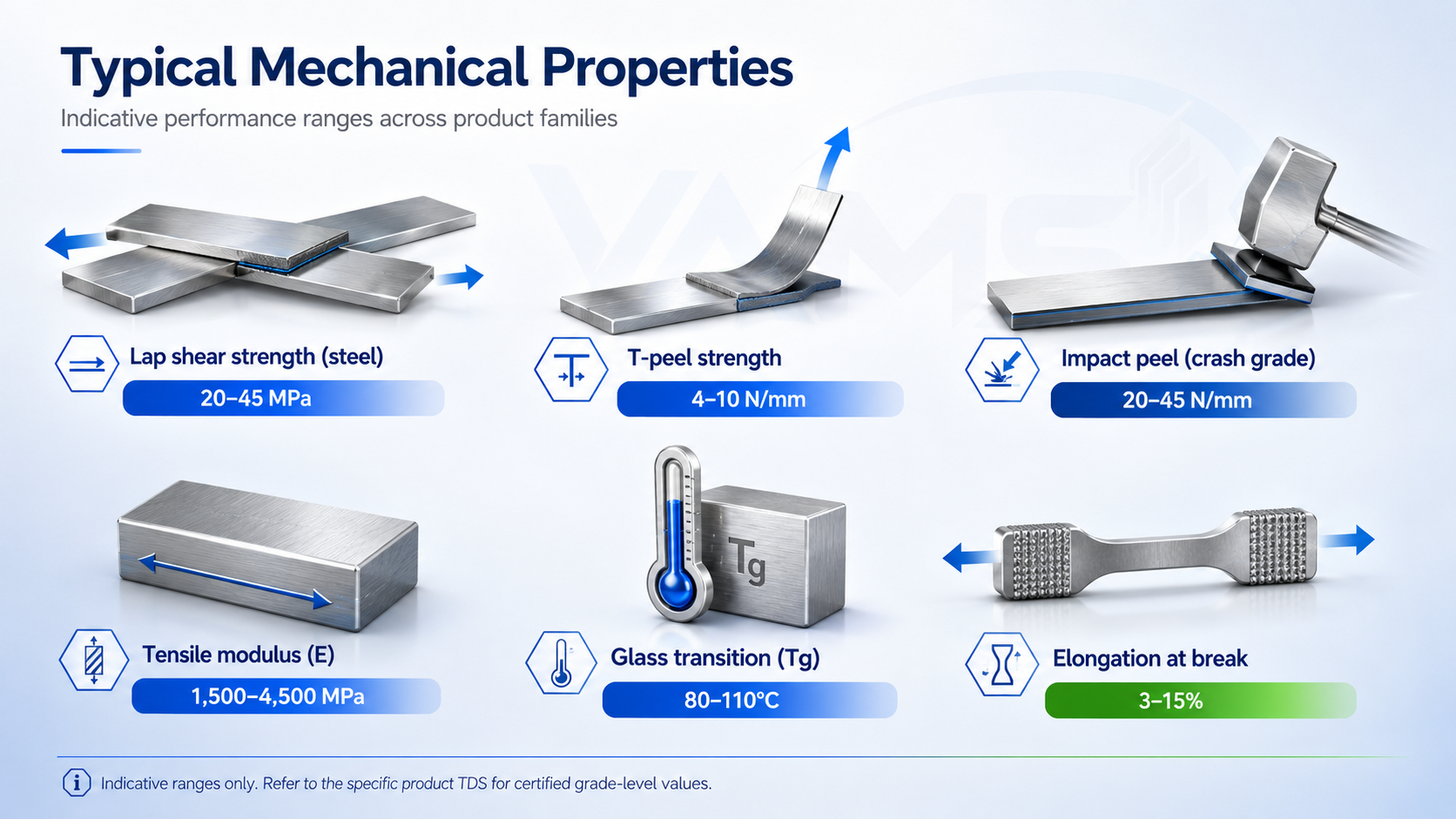
Key mechanical properties — lap shear, T-peel, impact peel, modulus and elongation
| Property | Standard | Indicative Value |
|---|---|---|
| Lap shear strength (steel) | ISO 4587 / DIN EN 1465 | 20–45 MPa |
| T-peel strength | ISO 11339 | 4–10 N/mm |
| Impact peel (wedge) | ISO 11343 | 20–45 N/mm (crash grade) |
| Tensile modulus (E) | ISO 527 | 1,500–4,500 MPa |
| Glass transition (Tg) | DSC | 80–110°C |
| Elongation at break | ISO 527 | 3–15% |
Indicative ranges across product families. Refer to the specific product TDS for certified, grade-level values.
Substrate Compatibility
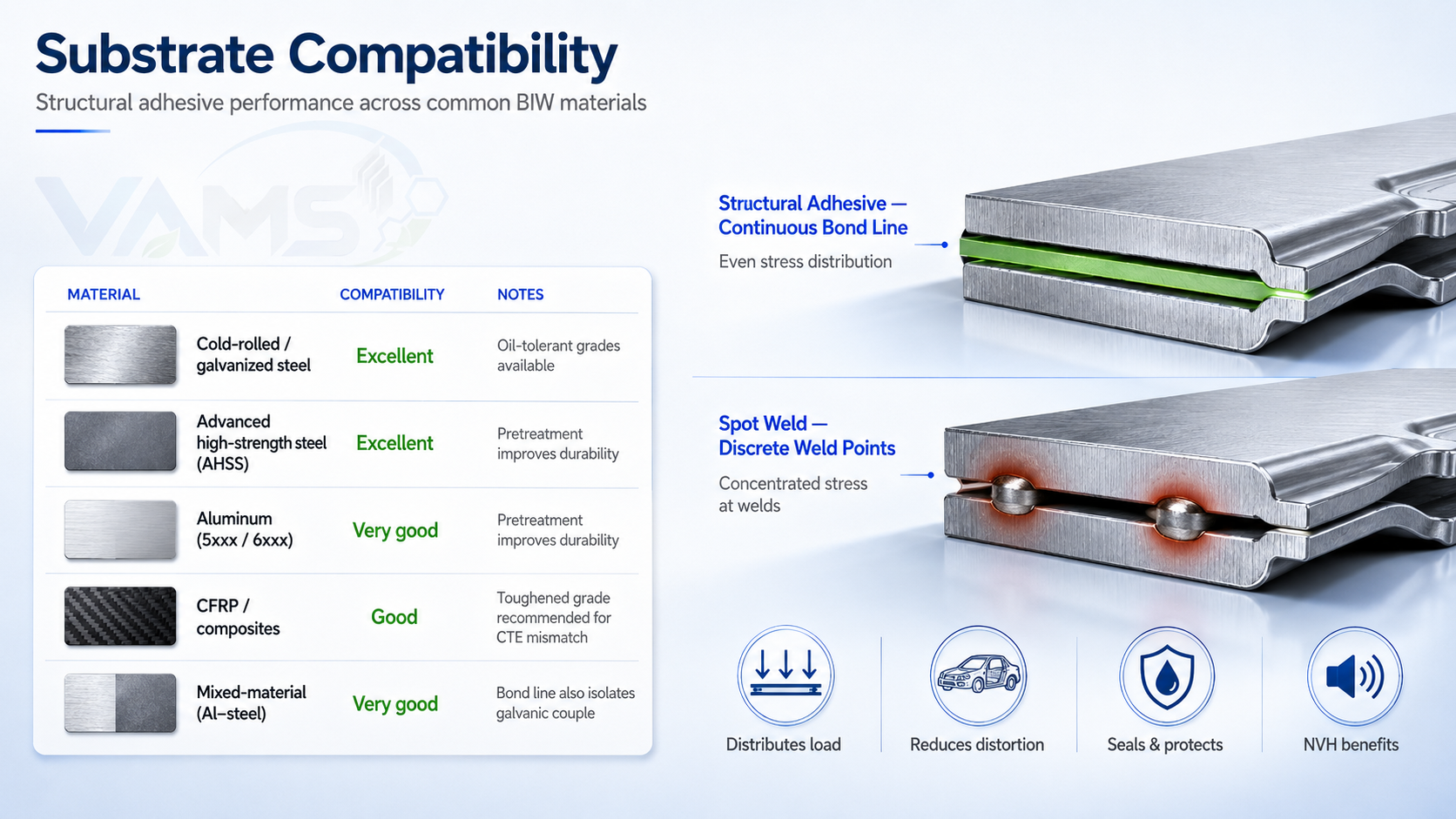
Compatibility across steel, AHSS, aluminum, CFRP and mixed-material joints
| Substrate | Compatibility | Surface / Notes |
|---|---|---|
| Cold-rolled / galvanized steel | Excellent | Bonds over typical mill oil (oil-tolerant grades) |
| Advanced high-strength steel (AHSS) | Excellent | Preserves base-metal strength vs. heat-affected welds |
| Aluminum (5xxx/6xxx) | Very good | Pretreatment / primer improves durability against galvanic & humidity |
| CFRP / composites | Good | Verify CTE mismatch; toughened grade recommended |
| Mixed-material (Al–steel) | Very good | Adhesive also isolates galvanic couple |
Application & Process Parameters
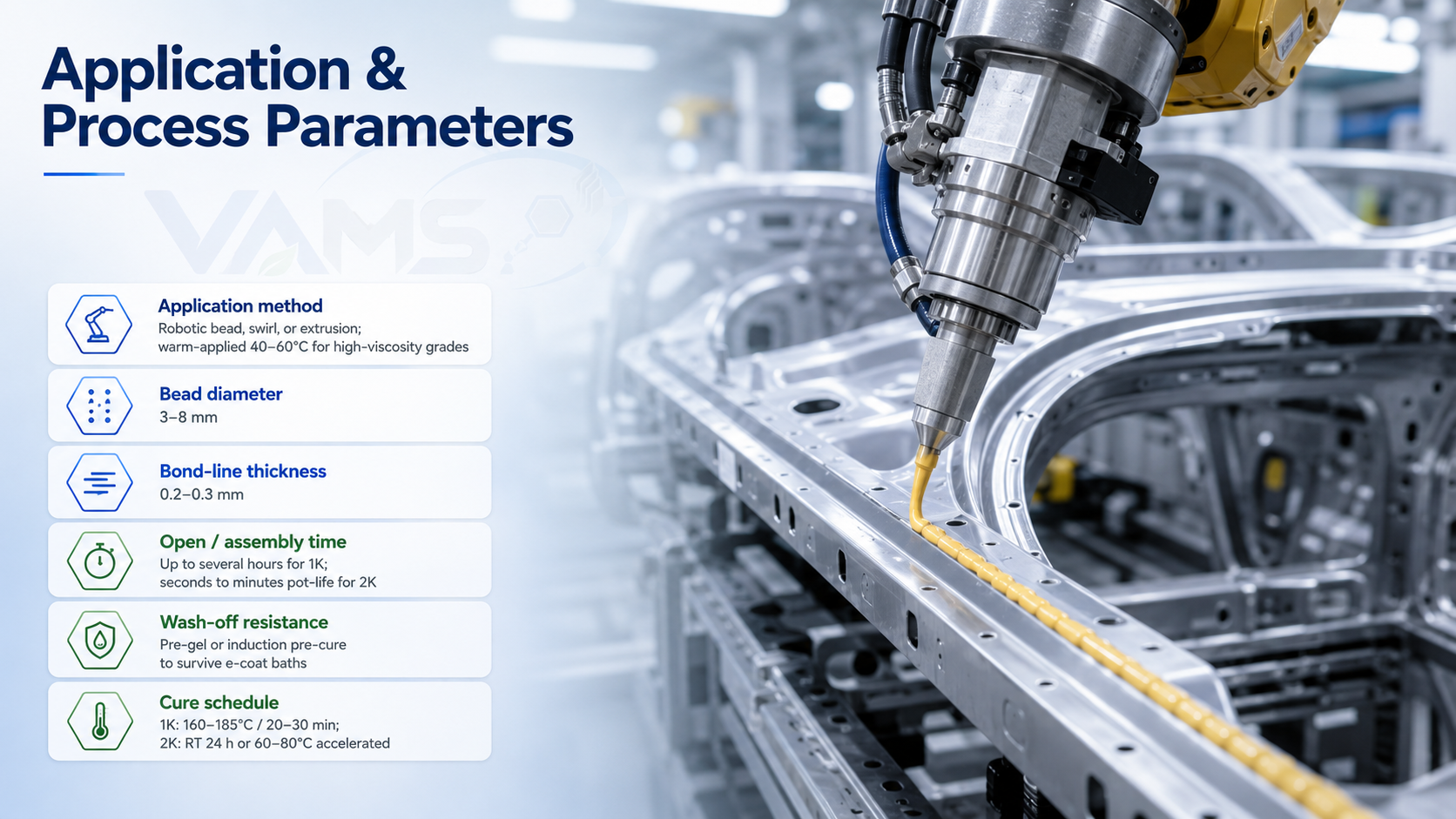
Application and cure parameters — bead, bond-line, wash-off resistance and paint-bake cure
| Parameter | Typical Window |
|---|---|
| Application method | Robotic bead, swirl, or extrusion; warm-applied (40–60°C) for high-viscosity grades |
| Bead diameter | 3–8 mm depending on flange width |
| Bond-line thickness | 0.2–0.3 mm (spacer beads/glass ballotini for control) |
| Open / assembly time | Up to several hours before cure (1K); pot-life seconds–minutes (2K) |
| Wash-off resistance | Pre-gel or induction pre-cure to survive e-coat baths |
| Cure schedule | 1K: 160–185°C / 20–30 min (paint-bake); 2K: RT 24 h or 60–80°C accel. |
Performance & Durability Considerations
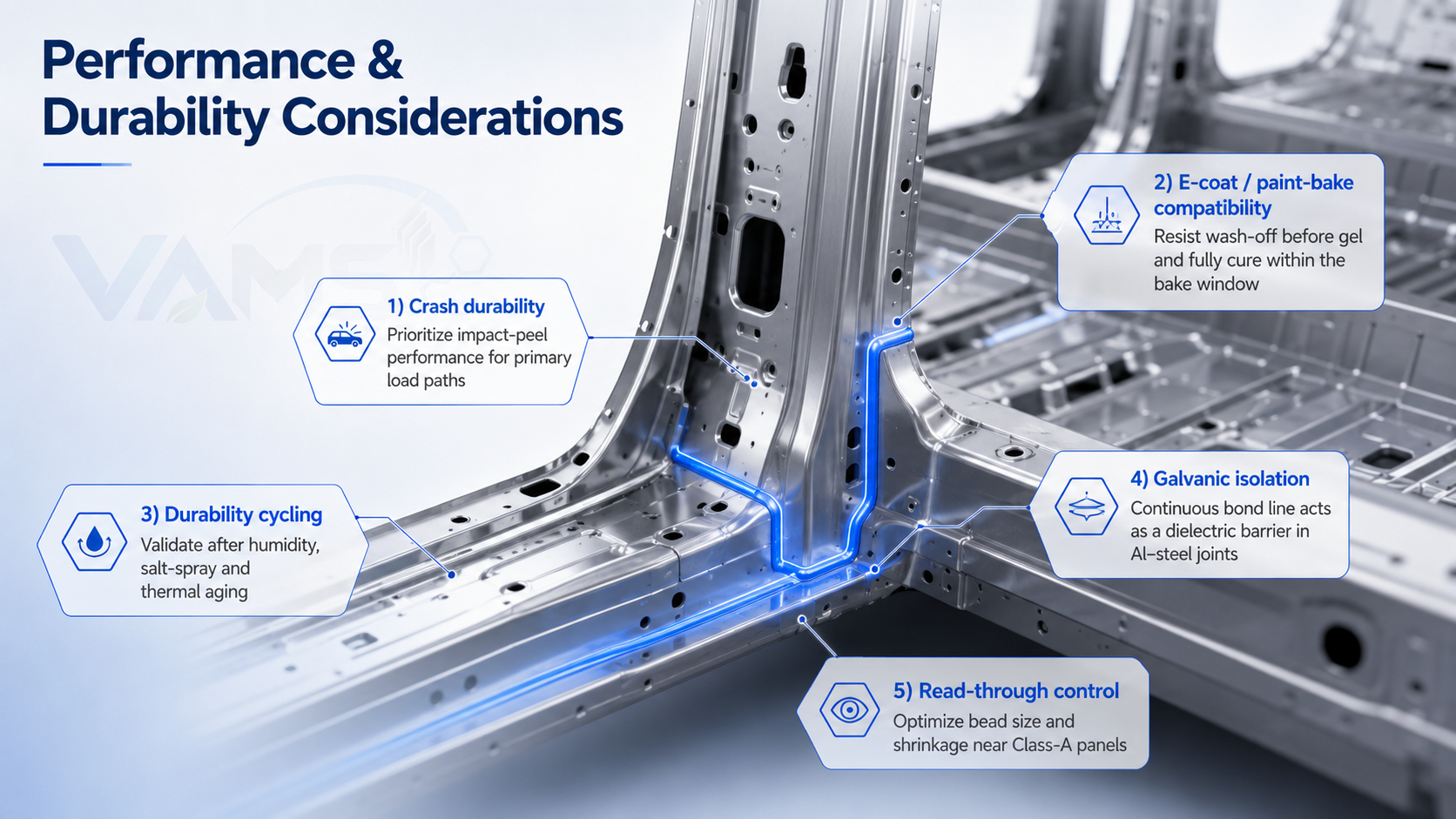
Crash durability, e-coat compatibility, corrosion cycling and galvanic isolation
- Crash durability: impact-peel (ISO 11343) is the key crash metric — prioritize toughened/crash-durable grades for primary load paths.
- E-coat / paint-bake compatibility: adhesive must resist wash-off before gel and fully cure within the bake window.
- Durability cycling: validate after humidity, salt-spray (e.g. cyclic corrosion) and thermal aging per OEM spec.
- Galvanic isolation: in Al–steel joints the bond line doubles as a dielectric barrier; maintain continuous coverage.
- Read-through: control bead size/shrinkage on Class-A adjacent panels.
Common Selection Mistakes
- Selecting structural adhesive only by lap shear strength
- Ignoring peel, impact peel and crash durability requirements
- Not validating adhesion on oily, coated or pre-treated substrates
- Overlooking e-coat wash-off and paint-bake compatibility
- Using adhesive in a joint design that cannot control bond-line thickness
- Ignoring galvanic corrosion risk in mixed-material joints
- Not validating fatigue, humidity, salt spray and thermal cycling
- Applying 2K adhesive without controlling mix ratio, open time and bead quality
Why VAMS
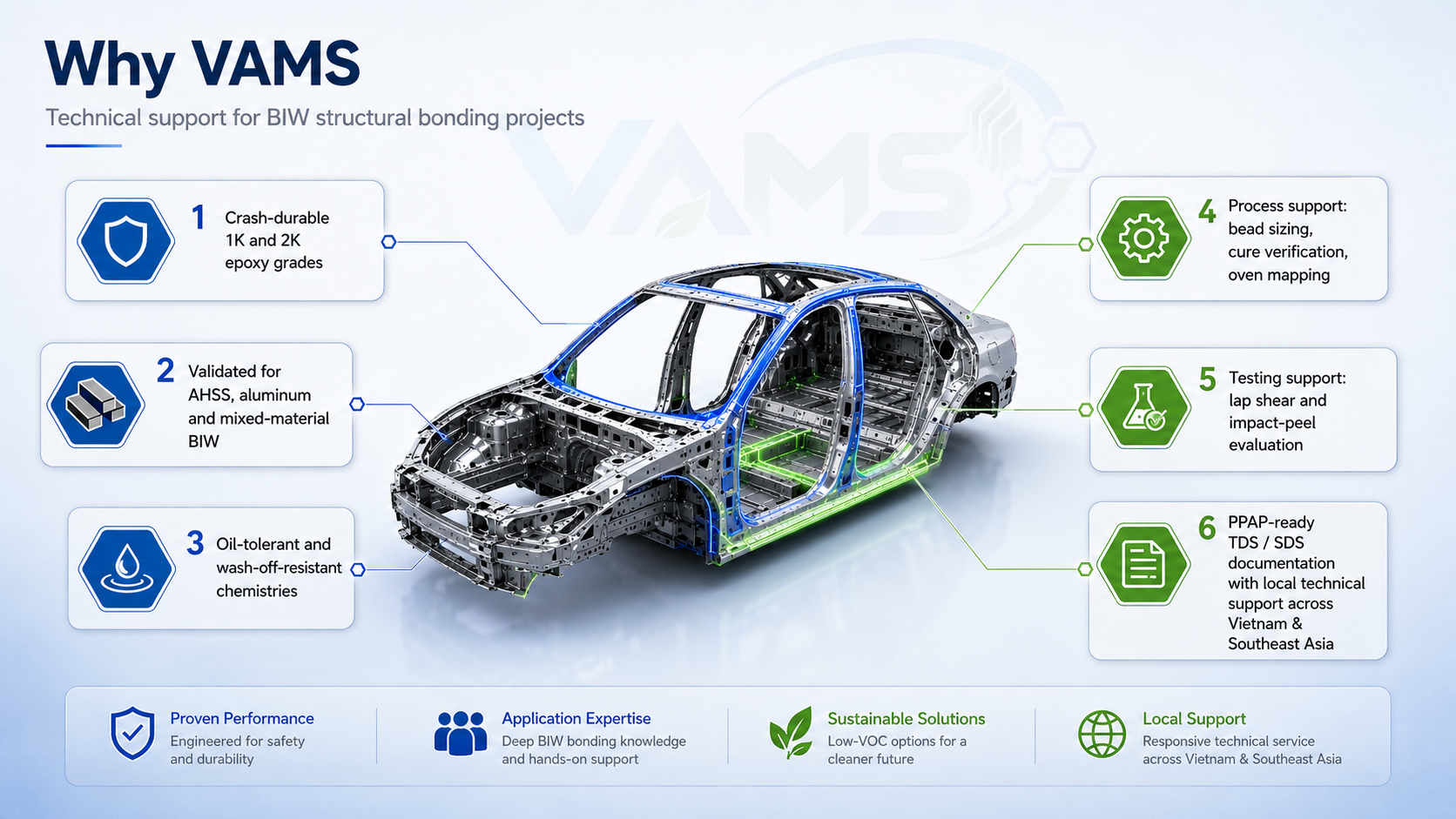
Why manufacturers choose VAMS structural adhesives for Body-in-White
- Crash-durable 1K and 2K epoxy grades validated for AHSS, aluminum and mixed-material BIW
- Oil-tolerant and wash-off-resistant chemistries for e-coat lines
- Process support: bead sizing, cure verification, oven mapping, lap-shear/impact-peel testing
- TDS/SDS and project documentation support for PPAP or customer approval for IATF 16949 production
- Local technical support and rapid sampling across Vietnam & Southeast Asia
Adhesives & Sealants for Body-in-White and General Assembly
Seam Sealing for Body-in-White
Need help selecting structural adhesives?
Tell us your substrates, joint design, cure process and load requirements. VAMS can help recommend suitable structural adhesives for your body-in-white assembly.