
Specialty Materials for EV and E-Scooter Battery Systems
Thermal management, IP sealing and materials supporting safety, reliability and compliance for EV & e-scooter battery packs
Values are typical reference ranges and may vary depending on material grade, cell format, pack design, compression level, curing condition and validation method.
A battery pack is only as reliable as the materials protecting it. From cell-level thermal management to full-pack IP sealing and thermal runaway barriers, VAMS supplies the specialty materials battery engineers need to build packs that are safe, efficient, and long-lasting.
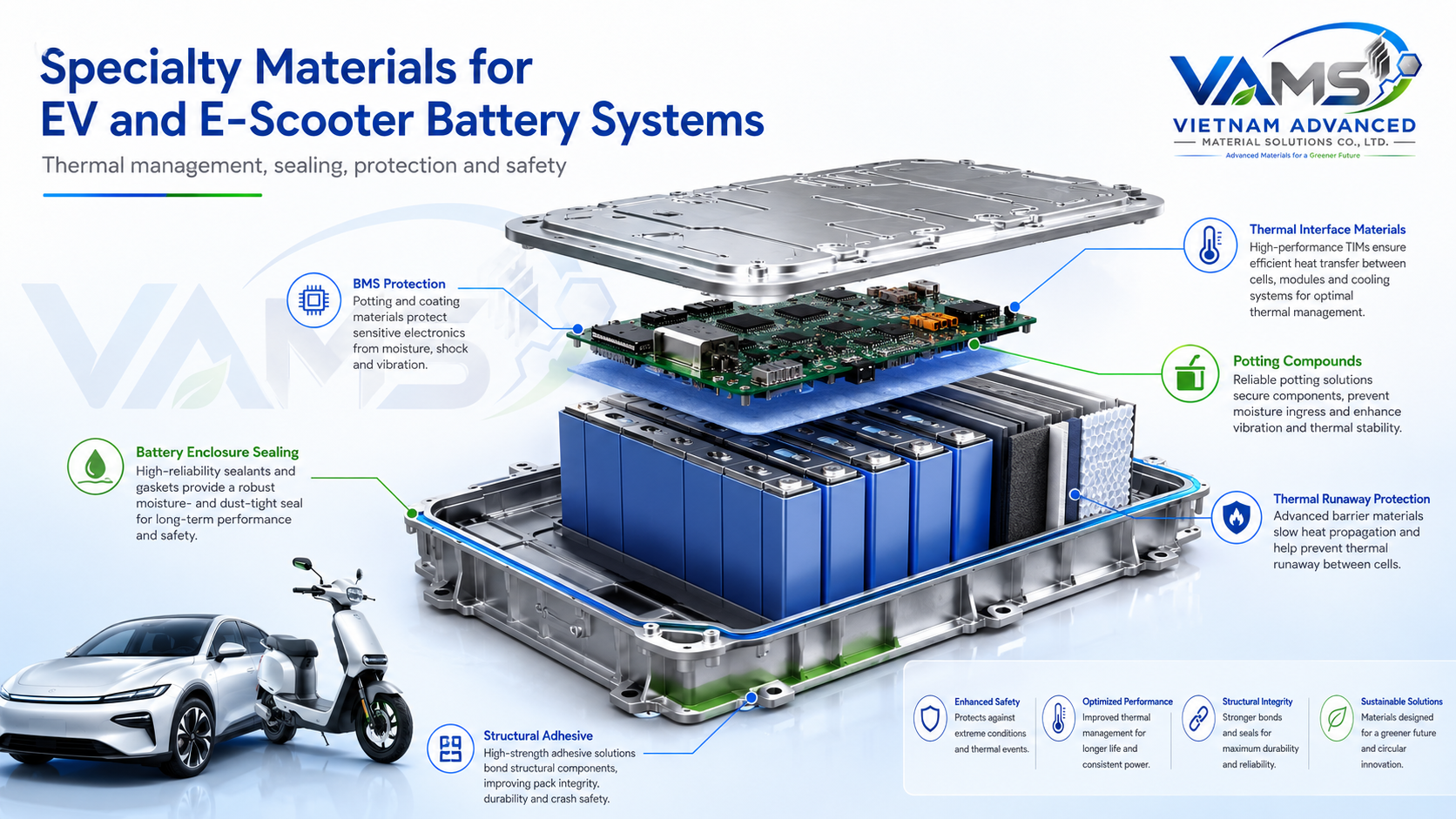
VAMS supplies the full material stack for battery packs — thermal interface, potting, enclosure sealing, and thermal runaway propagation mitigation
The Battery Pack: Where Every Material Decision Counts
The battery pack is one of the most cost- and safety-critical systems in an electric vehicle — and the one most sensitive to material choices. Too much heat shortens cell life. Too little sealing lets moisture destroy cells. A poorly bonded module can shift under vibration and cause a catastrophic short circuit.
VAMS specializes in specialty materials that protect battery cells, manage heat, seal the enclosure, and hold everything together — from small e-scooter packs to large commercial vehicle battery systems.
Thermal Interface Materials for Cell Cooling
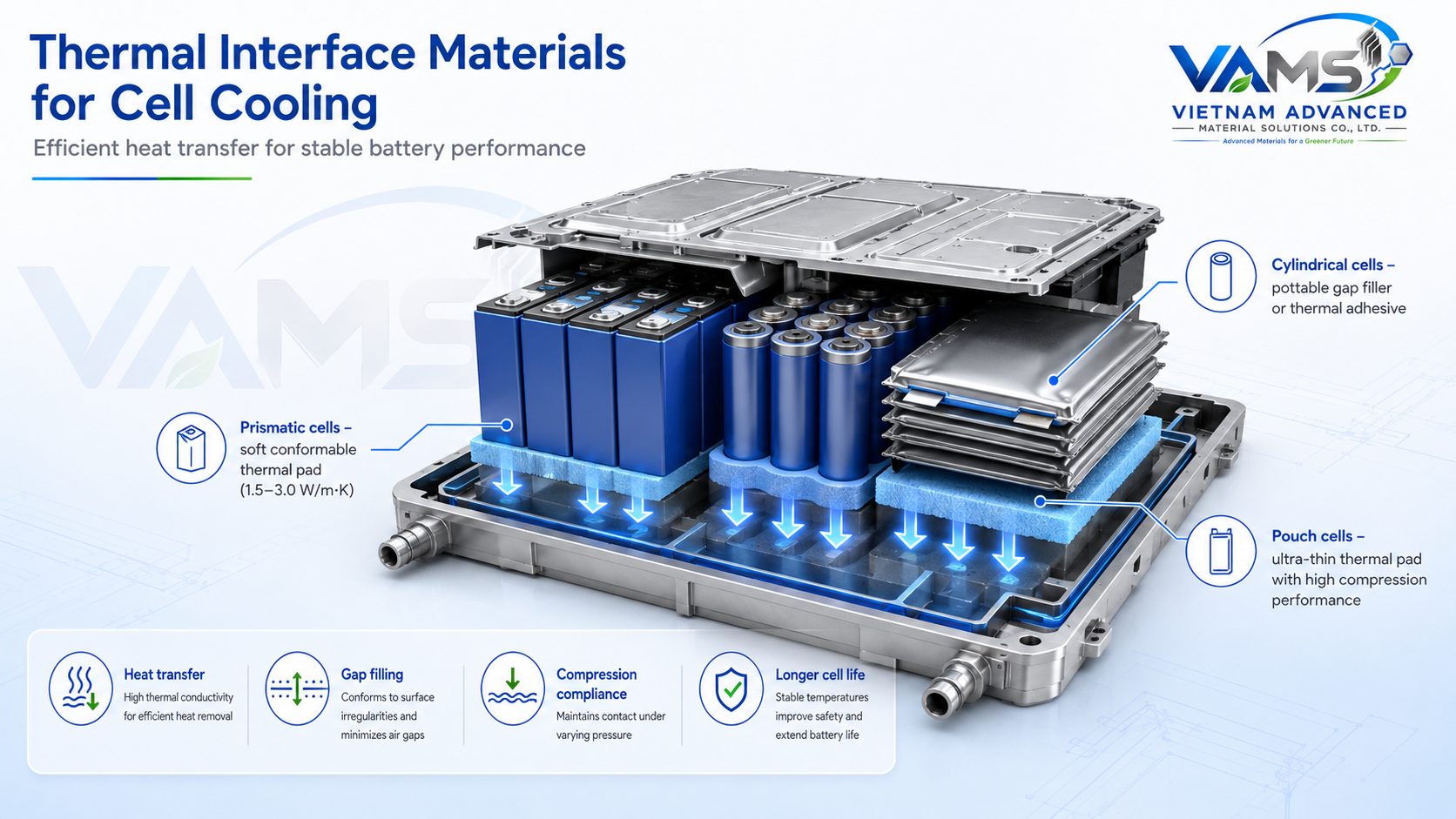
High-conductivity thermal pads and gap fillers bridge the gap between cell bottoms and the cooling plate, eliminating insulating air gaps
Lithium-ion cells operate most efficiently between 20°C and 40°C. The cooling plate removes heat from the cell bottom, but heat must first cross the interface between cell and plate — a junction filled with micro-air-gaps that act as thermal insulators. Thermal interface materials (TIMs) eliminate those air gaps and create a continuous, high-conductivity heat path.
Prismatic cells: Soft conformable thermal pad (1.5–3.0 W/m·K) — accommodates cell swelling over life
Cylindrical cells (18650 / 21700): Pottable gap filler or thermal adhesive for full bottom contact
Pouch cells: Ultra-thin thermal pad (0.5–1.0 mm) with high compression performance
Potting Compounds for Cell and Module Protection
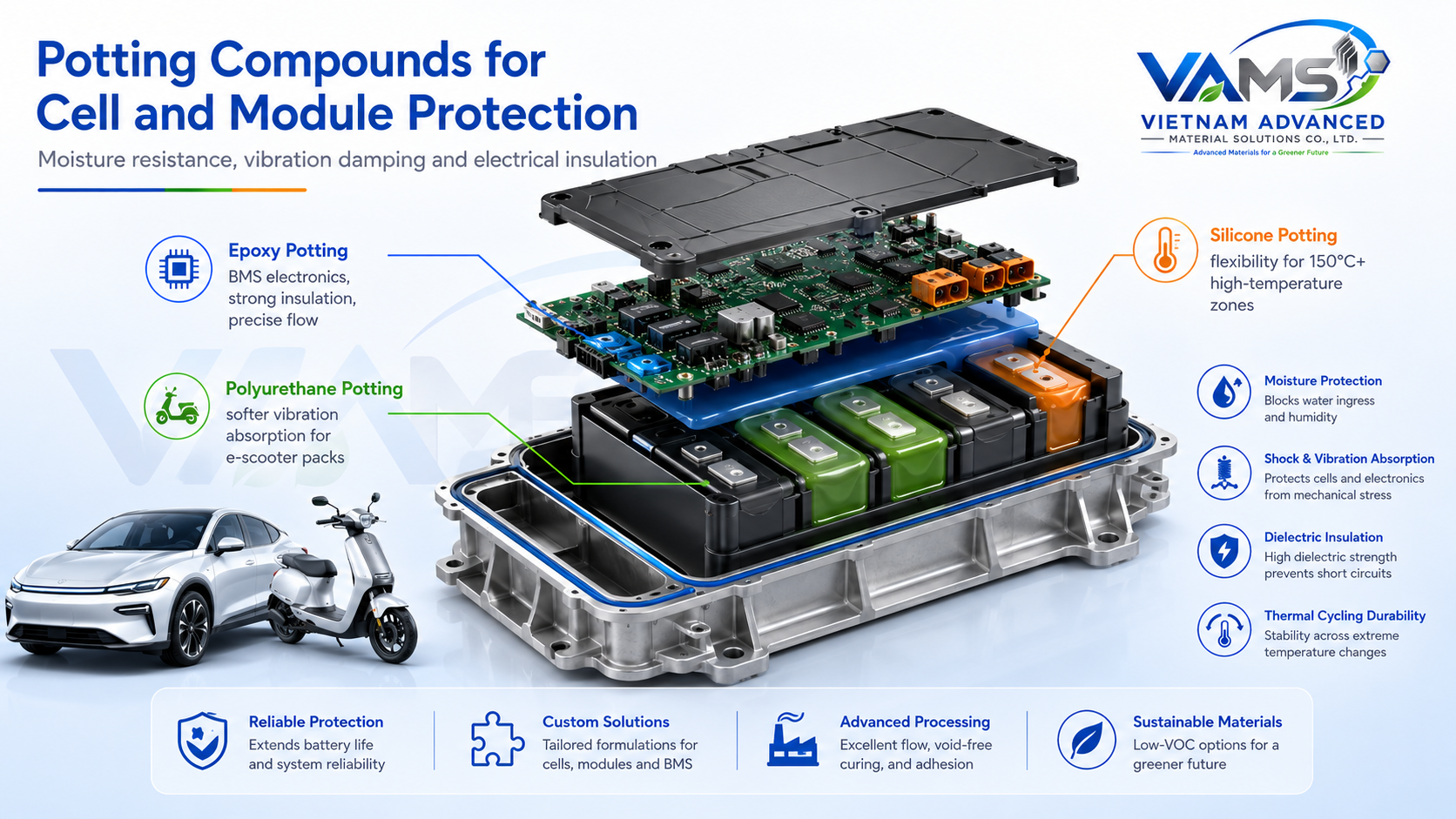
Epoxy, polyurethane, and silicone potting systems protect cells, modules, and BMS electronics against vibration, moisture, and heat
Epoxy Potting for BMS Electronics
Hard epoxy systems provide excellent electrical isolation and mechanical protection for BMS boards and connectors. Choose low-viscosity grades for good flow into complex PCB geometries without voids.
Polyurethane Potting for Vibration Environments
Softer PU systems absorb vibration stress better than rigid epoxies — ideal for e-scooter battery packs that see constant road vibration and occasional impacts.
Silicone Potting for High-Temperature Zones
Used where components are near high-heat areas. Silicone remains flexible at 150°C+ and resists thermal cycling fatigue better than epoxy or PU.
Battery Enclosure Sealing
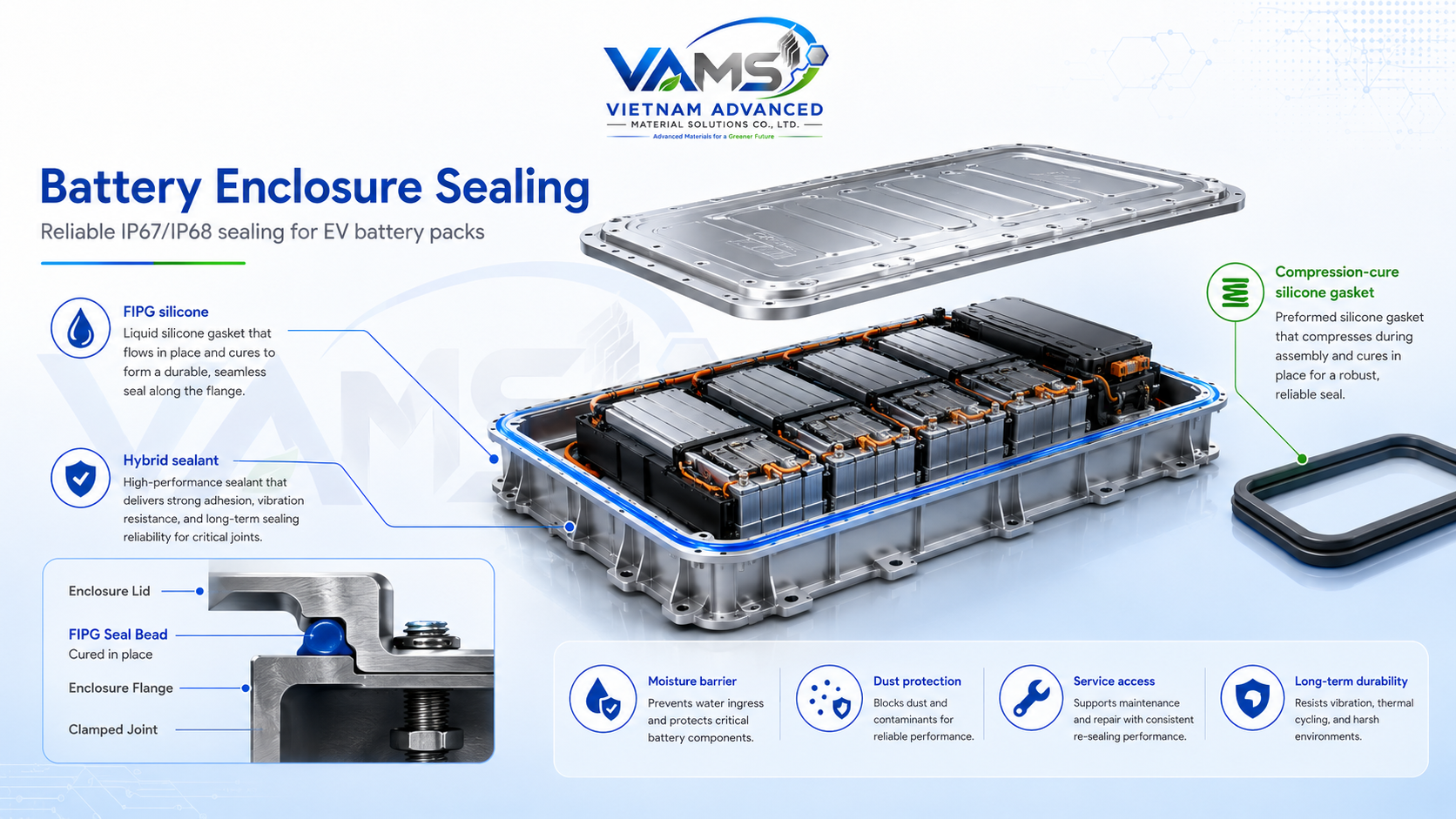
FIPG silicone and compression-cure gaskets seal the enclosure flange to IP67/IP68 — keeping moisture and dust out of the pack
IP67 or IP68 sealing on battery enclosures is non-negotiable. VAMS supplies silicone and hybrid FIPG (Formed-In-Place Gasket) materials for battery enclosure applications, as well as compression-cure silicone gaskets for service-access applications where the enclosure must be opened for maintenance.
Thermal Runaway Propagation Control
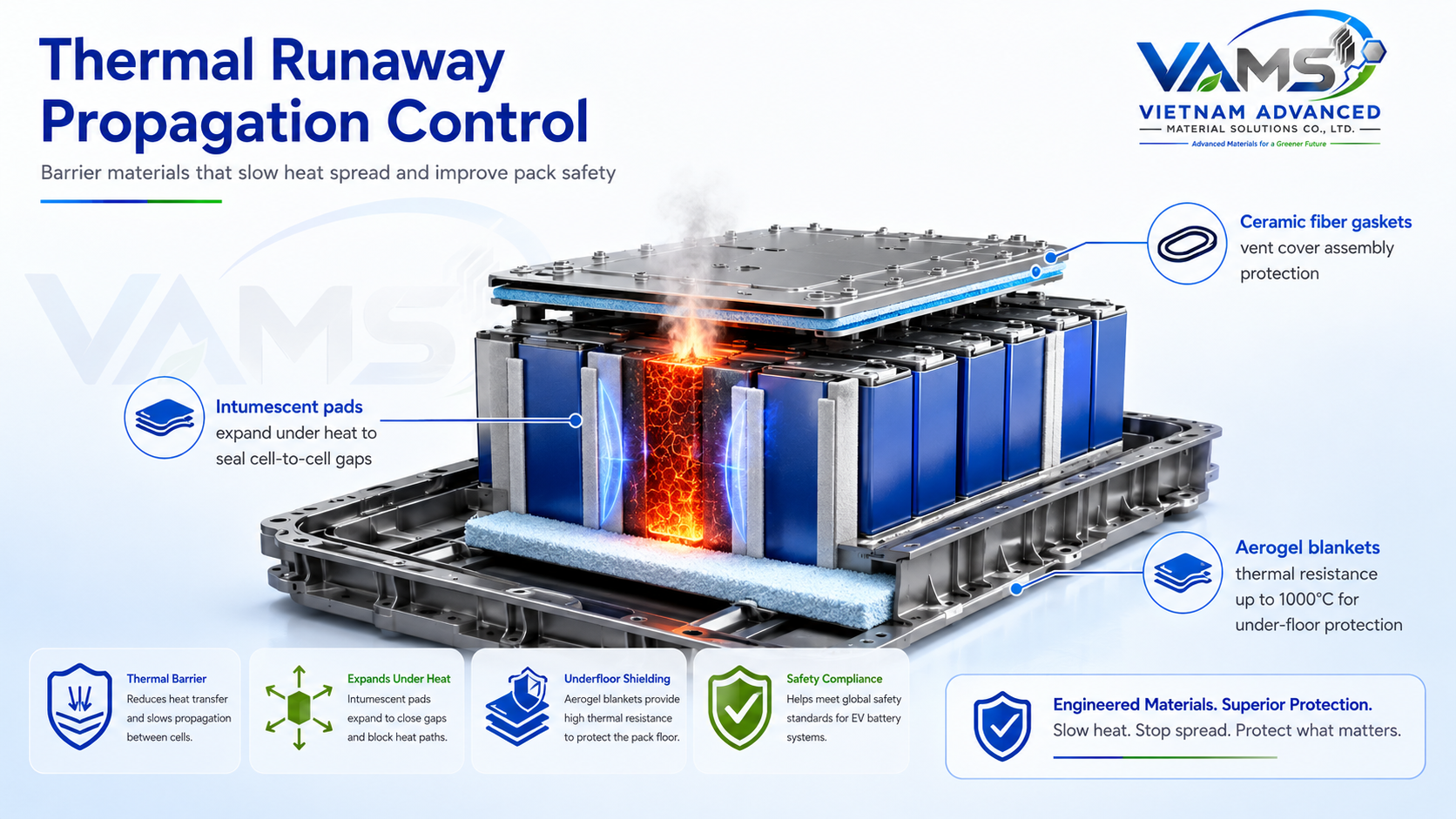
A layered defense — intumescent pads, aerogel blankets, and ceramic fiber gaskets slow cell-to-cell propagation and protect occupants
When a single cell enters thermal runaway, the goal is to stop the heat from spreading to neighboring cells and to give occupants time to escape — at least 5 minutes under ECE R100. VAMS supplies a layered system of barrier materials:
Intumescent pads that expand under heat to seal cell-to-cell gaps
Aerogel blankets with thermal resistance up to 1000°C for under-floor protection
Ceramic fiber gaskets for vent cover assemblies
Battery Pack Material Overview
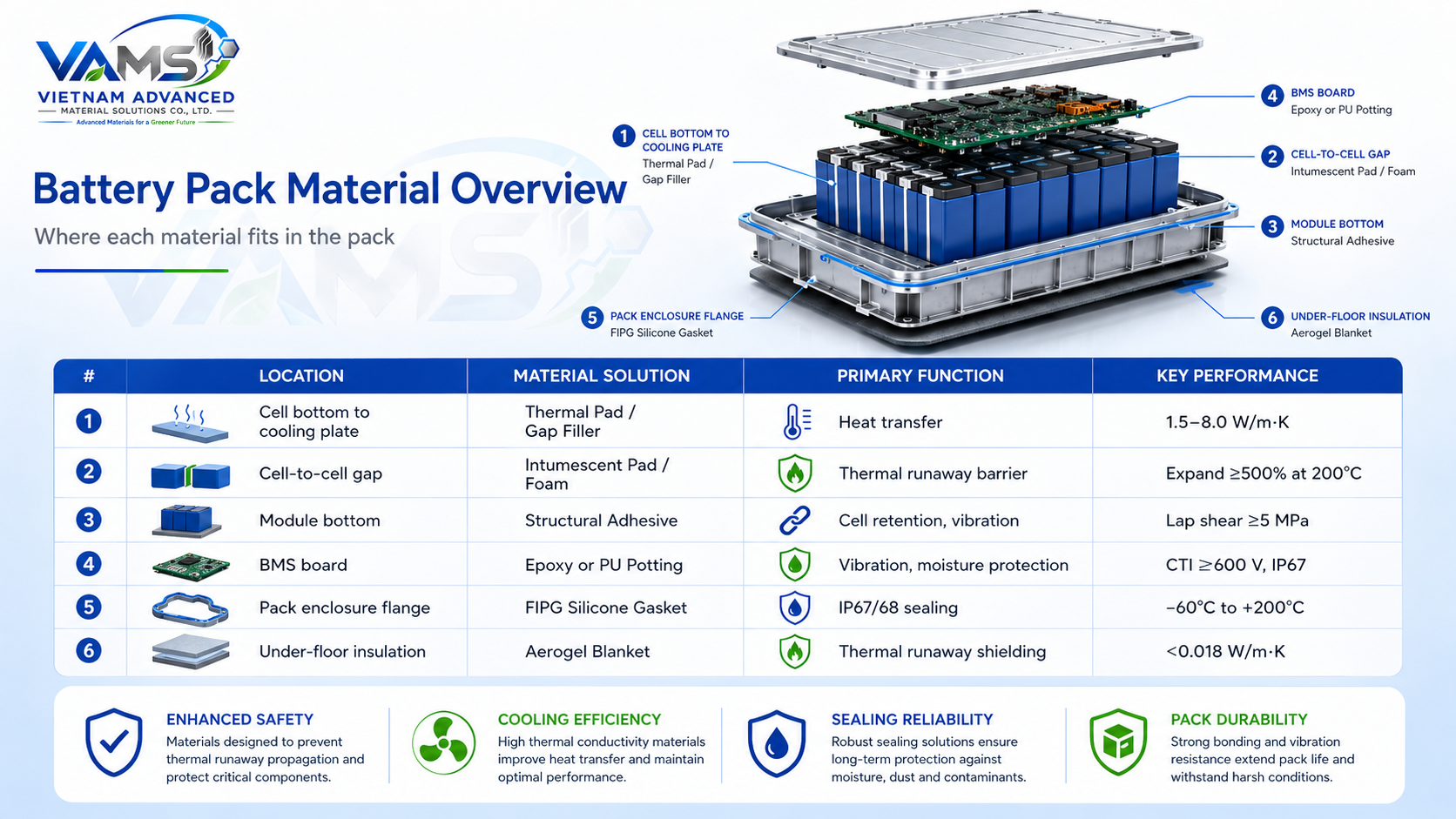
Every material mapped to its location in the pack — function and key specification at a glance
| Location in Pack | Material Type | Function | Key Spec |
|---|---|---|---|
| Cell bottom to cooling plate | Thermal Pad / Gap Filler | Heat transfer | 1.5–8.0 W/m·K |
| Cell-to-cell gap | Intumescent Pad / Foam | Thermal runaway barrier | Expand ≥500% at 200°C |
| Module bottom | Structural Adhesive | Cell retention, vibration | Lap shear ≥5 MPa |
| BMS board | Epoxy or PU Potting | Vibration, moisture protection | CTI ≥600 V, IP67 |
| Pack enclosure flange | FIPG Silicone Gasket | IP67/68 sealing | –60°C to +200°C |
| Under-floor insulation | Aerogel Blanket | Thermal runaway shielding | <0.018 W/m·K |
VAMS Technical Support for Battery Engineers
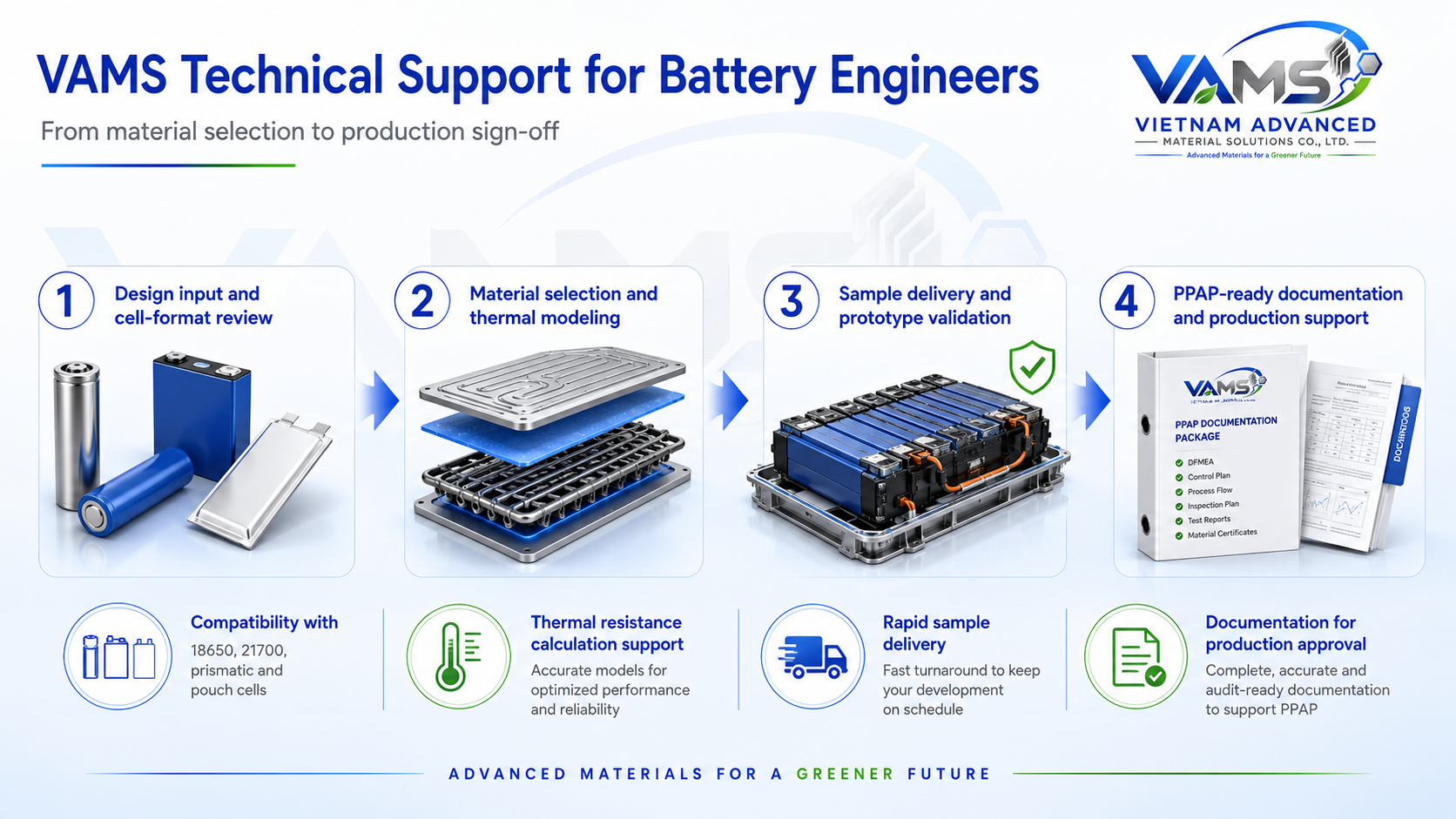
From material selection to production sign-off — VAMS supports battery engineers at every stage of development
- Material selection based on cell chemistry, cooling architecture, and pack geometry
- Thermal resistance calculation and heat transfer modeling support
- Compatibility testing data with major cell formats (18650, 21700, prismatic, pouch)
- Sample coordination for prototype validation
- TDS/SDS and project documentation support for PPAP or customer approval for production sign-off
Thermal Gap Filler for EV Battery Packs
Aerogel & PC Sheet Thermal Barriers
Thermal Interface Materials (TIM)
Thermal Pads Selection Guide
Potting Compounds Guide
Need help selecting battery pack materials?
Tell us your cell format, thermal load, sealing class and safety requirements. VAMS can help recommend suitable thermal interface, potting, sealing and thermal runaway materials for your pack.