
Specialty Materials for Energy Storage Systems (ESS/BESS)
Thermal management, fire propagation control and outdoor sealing for stationary energy storage systems
Values are typical reference ranges and may vary depending on cell chemistry, rack design, barrier thickness, enclosure structure, installation environment and validation method.
Grid-scale and commercial energy storage systems live outdoors for two decades, cycling daily through extreme heat, cold, humidity, and UV. The materials inside a BESS cabinet must manage cell heat, delay fire propagation, seal against the weather, and remain stable through demanding outdoor conditions. VAMS supplies a broad material set designed for stationary energy storage environments, where long-term outdoor stability, thermal control, sealing reliability and fire-propagation control must be validated at system level.
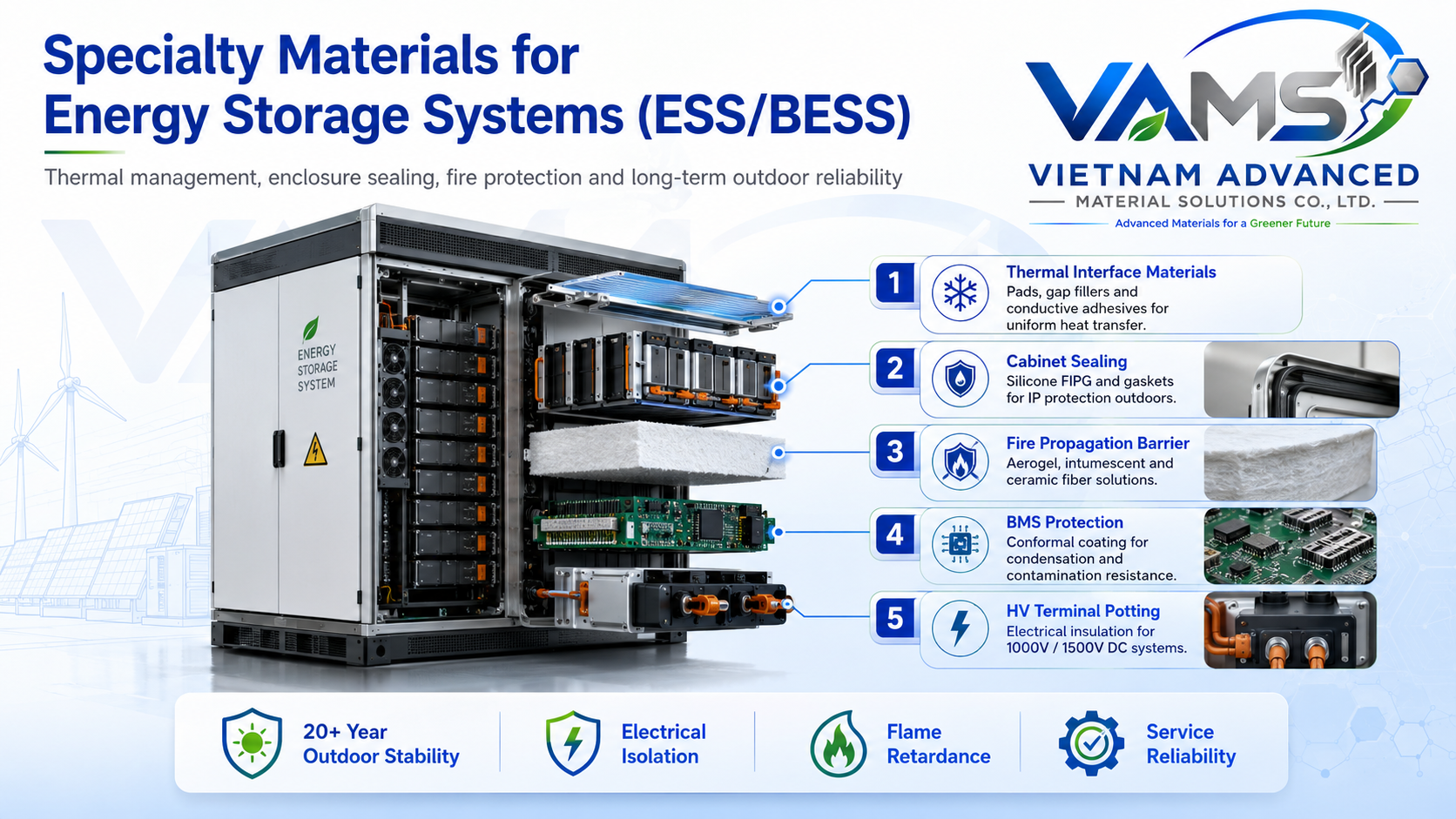
VAMS supplies thermal interface materials, fire propagation barriers, enclosure sealing, and weather protection for grid and outdoor energy storage
Energy Storage Has Its Own Material Rules
A stationary BESS is not just a scaled-up EV battery. It runs in fixed outdoor cabinets over a long service life, faces continuous daily cycling, and must support system-level fire-safety requirements such as NFPA 855 and UL 9540A. That changes every material decision: thermal interfaces must stay stable through far more cycles, fire barriers must contain propagation across a large rack, and enclosure seals must withstand long-term UV and weather exposure.
VAMS supplies thermal interface materials, intumescent and aerogel fire barriers, FIPG enclosure sealing, and weather-resistant gasketing — all validated for the long service life and safety requirements of energy storage.
Thermal Management in BESS Enclosures
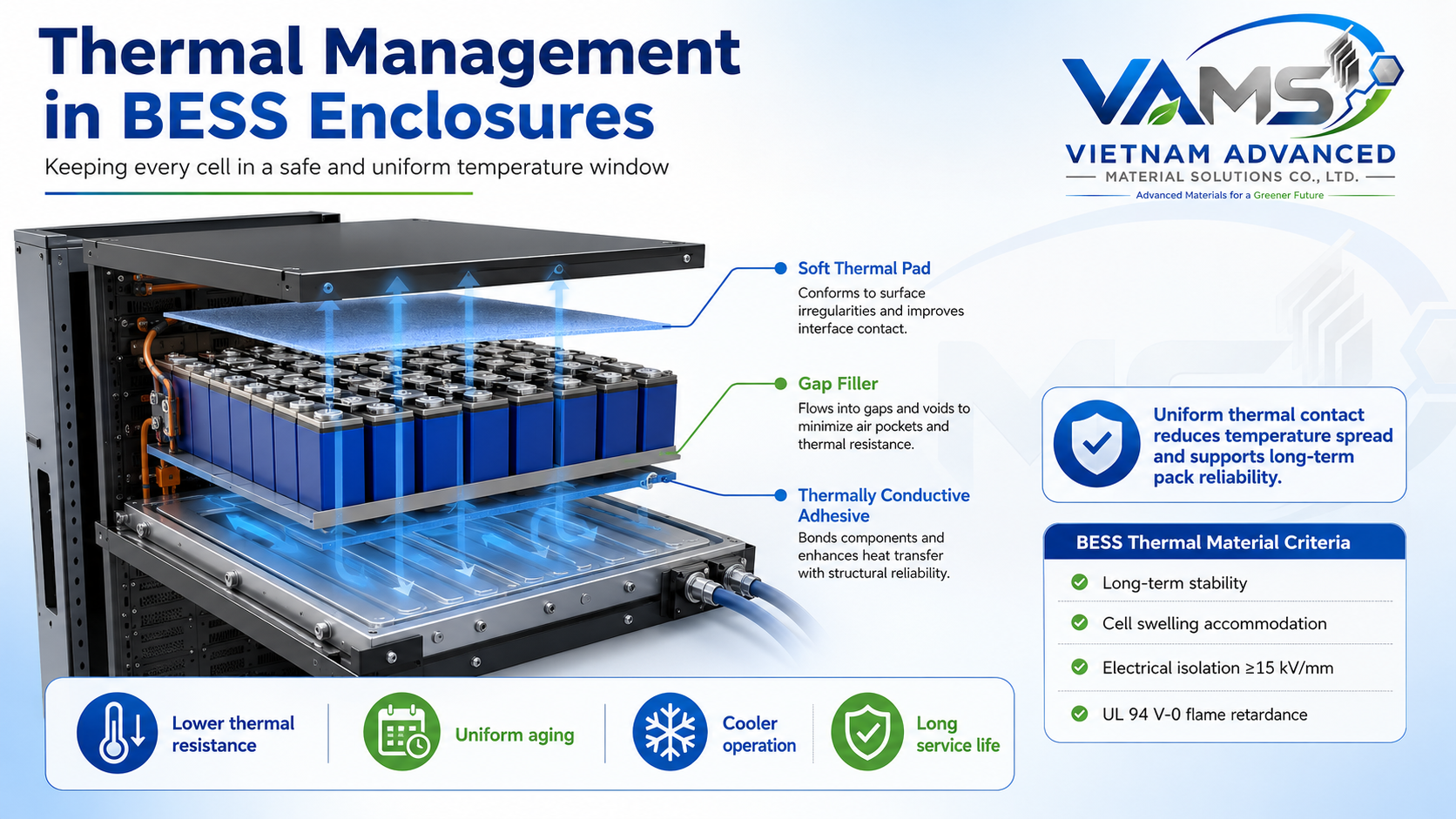
Soft gap fillers and thermal pads keep cells in a uniform temperature window, extending cycle life and preventing hot-spot ageing
Cell life in a BESS depends on keeping every cell inside a tight, uniform temperature window — temperature gradients across a rack cause uneven ageing and premature capacity loss. VAMS soft gap fillers and thermal pads bridge cells to cooling plates and heat sinks with low thermal resistance, while remaining soft enough to absorb stack tolerances and long-term cell movement.
Longer life: Tighter temperature uniformity slows capacity fade across the rack
Lower thermal resistance: Gap fillers eliminate insulating air gaps at the cell interface
Tolerance absorption: Soft, conformable materials accommodate cell swelling over a long service life
Fire Propagation Prevention
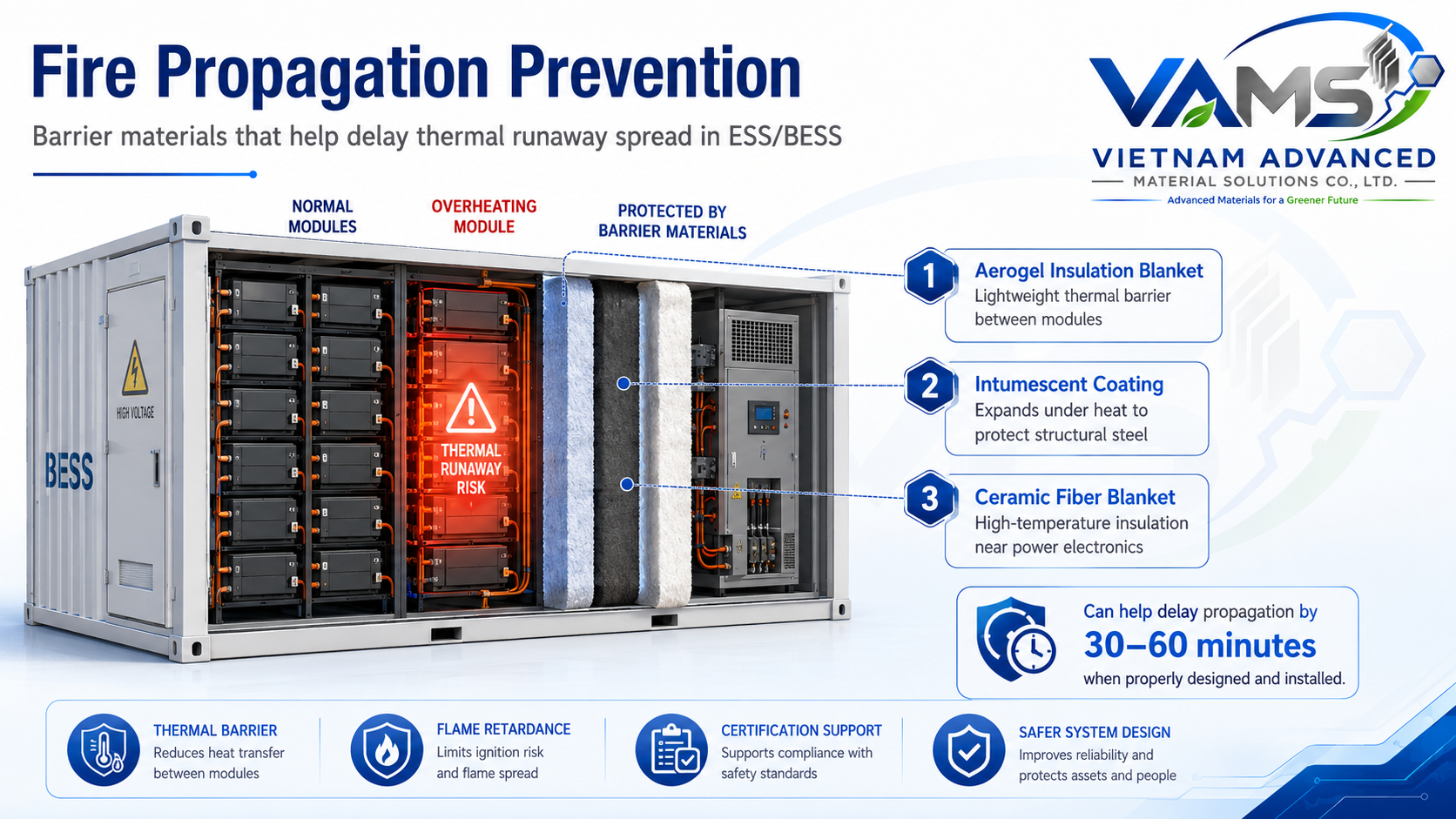
Aerogel insulation, intumescent coatings and ceramic fiber blankets delay thermal runaway spread between cells and modules by 30–40 minutes
If one cell enters thermal runaway, the priority is to stop the heat and flame from spreading to neighboring cells and modules — buying time for safe shutdown and emergency response. VAMS fire barrier materials build a layered defense across the rack:
Aerogel insulation blankets — lightweight, ultra-low conductivity barriers between cells and modules
Intumescent coatings — expand under heat to seal gaps and block flame paths
Ceramic fiber blankets — high-temperature protection for partitions and barriers
Enclosure Sealing and Weather Protection
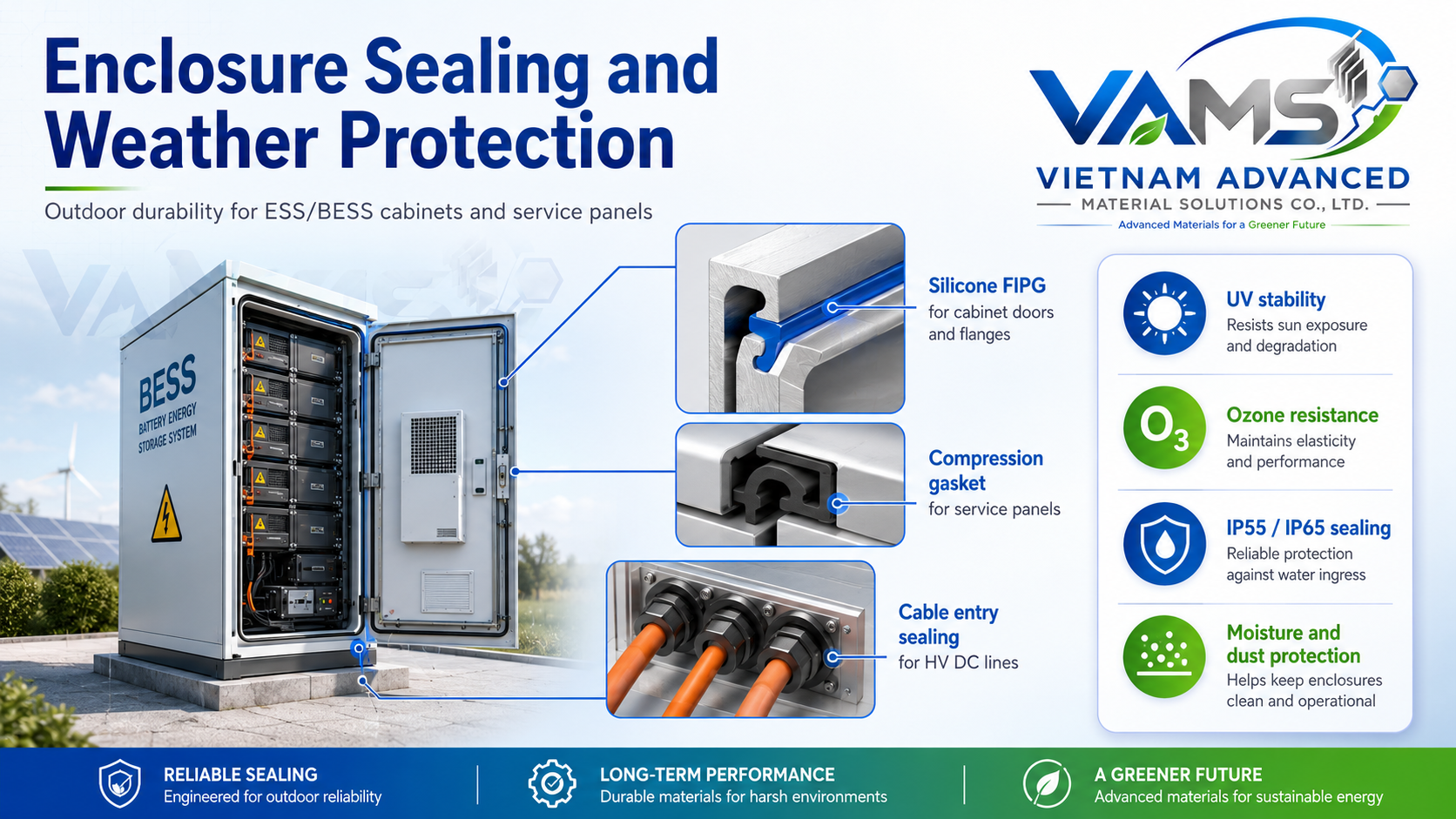
Silicone FIPG, compression gaskets and cable-entry seals keep moisture, dust and UV out of outdoor BESS cabinets for the full service life
Outdoor BESS cabinets must keep water, dust, and UV out over a long outdoor service life. VAMS supplies silicone FIPG (Formed-In-Place Gasket) for cabinet flanges, compression gaskets for service-access panels, and dedicated cable-entry seals — all UV-stable and rated for long-term outdoor exposure.
Silicone FIPG
Formed-in-place gasketing for cabinet seams and door flanges — conforms to complex geometries and cures in place for a reliable, repeatable seal.
Compression Gaskets
Reusable seals for service-access panels that must be opened for maintenance without compromising the IP rating.
Cable-Entry Sealing
Sealing for cable and conduit penetrations — the most common ingress points on an outdoor enclosure.
BESS Material Specification Guide
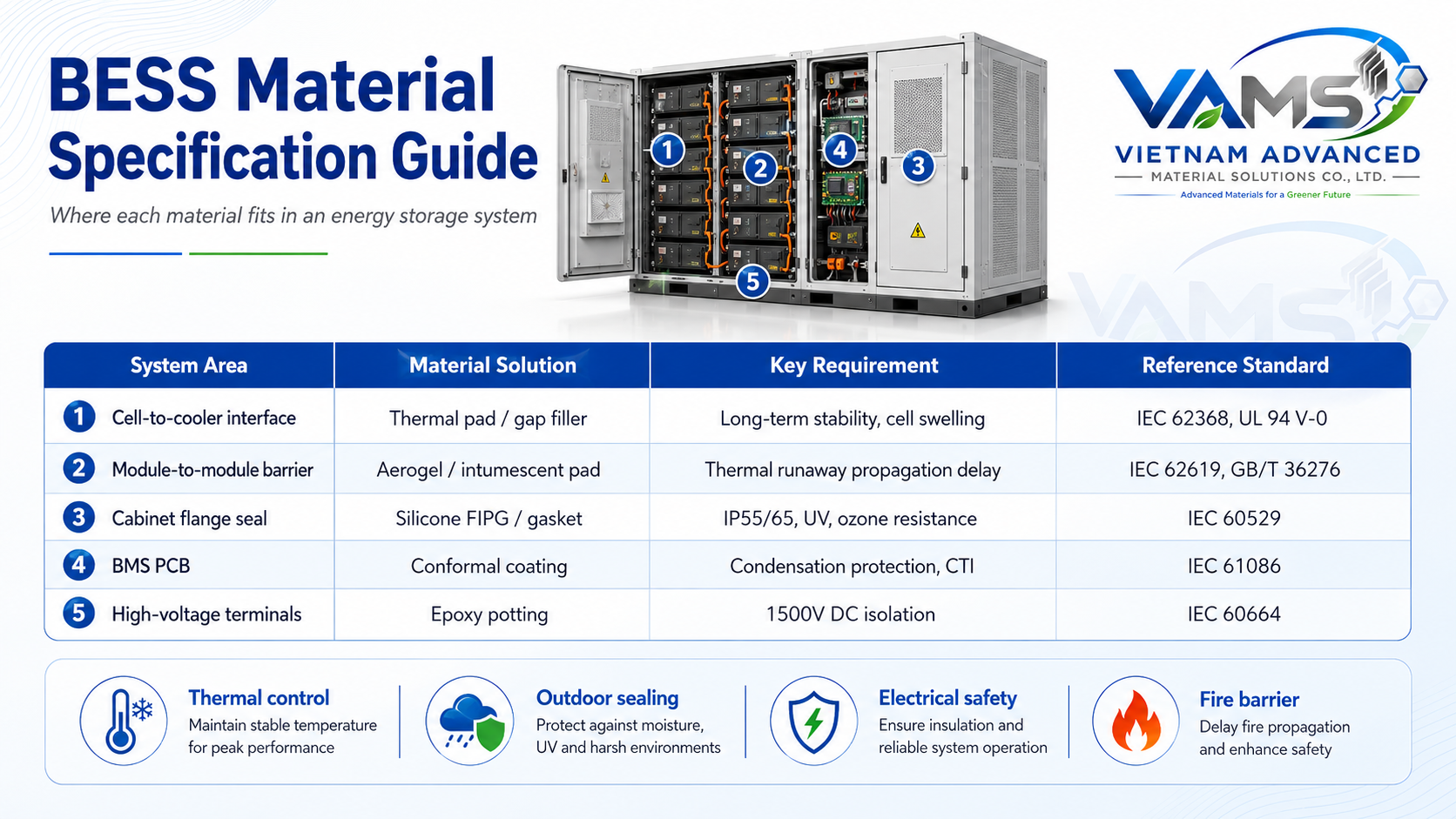
VAMS material recommendations mapped to each system area, with key requirement and reference standard
| System Area | Material Solution | Key Requirement | Reference Standard |
|---|---|---|---|
| Cell-to-cooler interface | Thermal pad / gap filler | Long-term stability, cell swelling | IEC 62368, UL 94 V-0 |
| Module-to-module barrier | Aerogel / intumescent pad | Thermal runaway propagation delay | IEC 62619, GB/T 36276 |
| Cabinet flange seal | Silicone FIPG / gasket | IP55/65, UV & ozone resistance | IEC 60529 |
| BMS PCB | Conformal coating | Condensation protection, CTI | IEC 61086 |
| High-voltage terminals | Epoxy potting | 1500V DC isolation | IEC 60664 |
VAMS for Energy Storage Project Teams
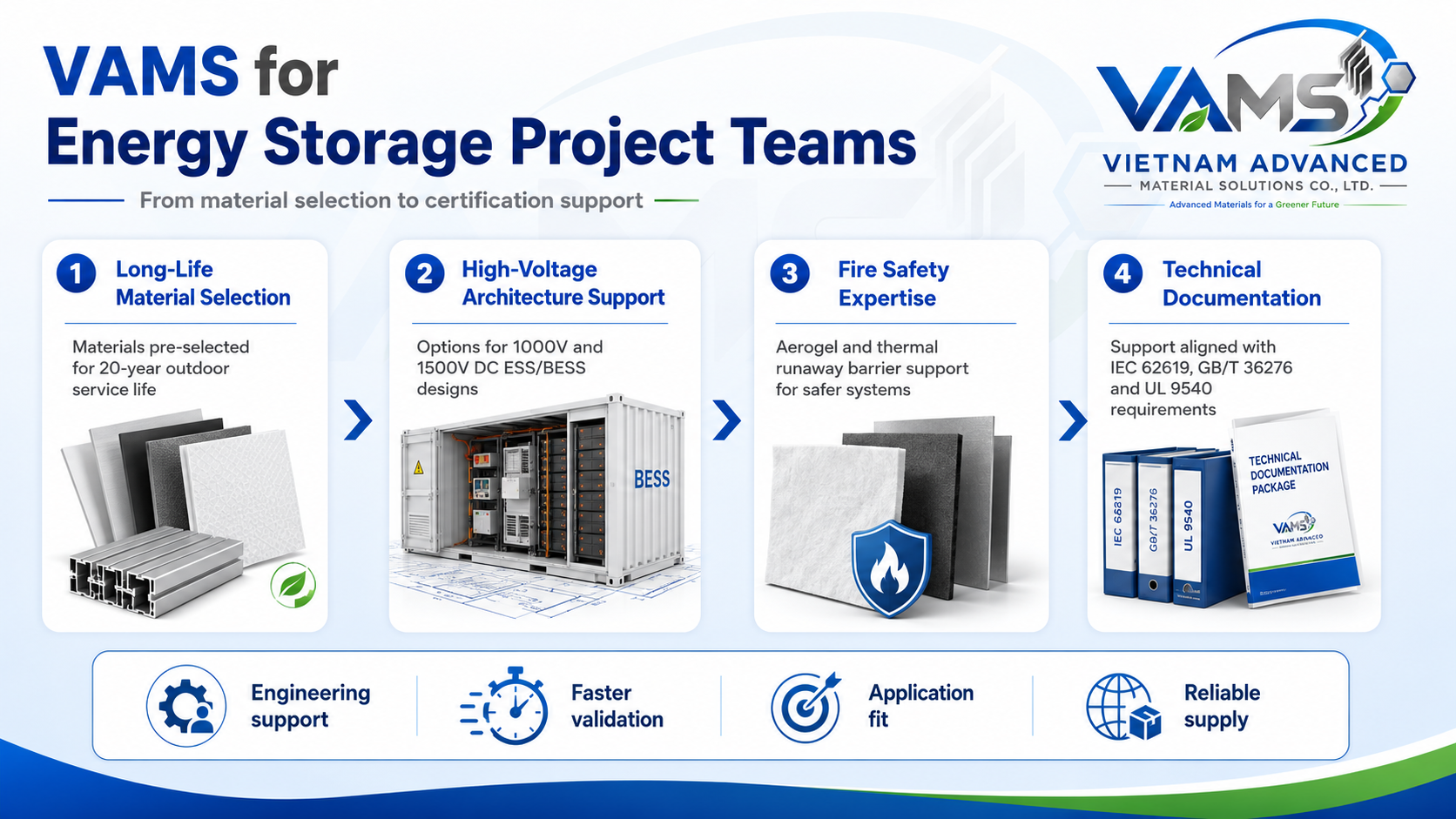
From material selection to certification support — VAMS partners with energy storage project teams end to end
- Long-life material selection matched to outdoor service life and daily cycling demands
- High-voltage architecture support — dielectric isolation, creepage and clearance
- Fire-safety material expertise supporting NFPA 855 and UL 9540A system-level propagation requirements
- Technical documentation and reference-standard data for project certification and sign-off
- Reliable supply and rapid sampling for prototype and pilot installations
Thermal Gap Filler for EV Battery Packs
Aerogel & PC Sheet Thermal Barriers
Thermal Interface Materials (TIM)
Potting Compounds Guide
Need help selecting ESS / BESS materials?
Tell us your module design, enclosure class, thermal load and safety requirements. VAMS can help recommend suitable thermal, sealing, potting and thermal runaway barrier materials for your system.